Sleep paralysis demon: why you see a figure you can't escape
Awake, unable to move, and certain something is in the room with you. It is one of the most terrifying things the sleeping brain does — and one of the most explainable.
9 min read · General wellness information, not a medical diagnosis · Auf Deutsch lesen →
The short answer
The 'sleep paralysis demon' is a hallucination, not a real presence. During sleep paralysis your mind wakes before REM's natural muscle-paralysis has switched off, so you are conscious but frozen and still partly dreaming — and the brain's threat system, shallow REM breathing and raw fear combine to build a sensed intruder. It is harmless and always ends on its own; regular, sufficient sleep is the best prevention.
It is one of the most frightening things a human being can experience while, technically, perfectly safe in bed. You wake up. Your mind is clear and alert. But your body will not move — not a hand, not your voice — and you are seized by the absolute certainty that someone, or something, is in the room with you. People report it in astonishingly consistent detail across the entire world: the shadowy figure, the crushing weight on the chest, the pure dread. Different cultures have given the intruder different names — a witch, a hag, a demon, a djinn, the "old hag" who sits on your chest. It is so universal that it has a plain, unfrightening scientific name: sleep paralysis. And the "demon" is a hallucination your own brain is generating.
Why your body freezes during the sleep paralysis demon
The freezing part is not a malfunction — it is a safety feature caught at the wrong moment. During REM sleep, the stage where most vivid dreaming happens, your brain deliberately paralyses the body's muscles so that you do not physically act out your dreams. This is normal, and it is protective: without it, you would kick, run and punch your way through the night. Sleep paralysis is what happens when the timing slips — your mind wakes up before that REM paralysis has been switched back off. For anywhere from a few seconds to a couple of minutes, you are fully conscious but still held in dream-paralysis. You cannot move, you cannot call out, and it is genuinely terrifying — but it is not dangerous, and it always resolves on its own. (The direct, reassuring version of that answer is in can sleep paralysis kill you.) The experience is common enough — and striking enough — that it has shaped folklore worldwide, a cross-cultural thread documented in the Wikipedia sleep paralysis article.
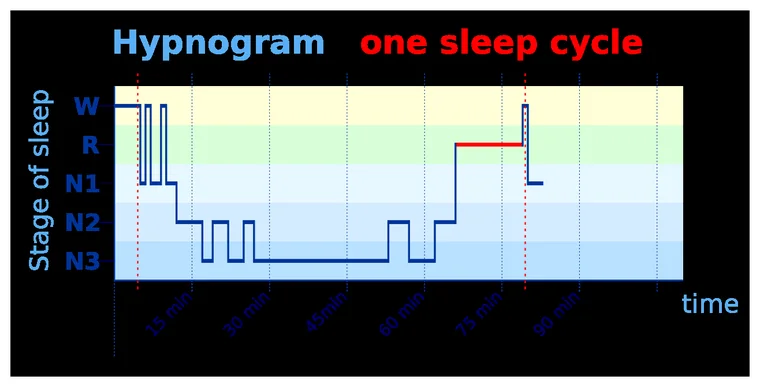
Seeing where it sits in the night makes it less mysterious: REM is concentrated in the second half of the night, so sleep paralysis most often strikes in the early morning hours or when you are surfacing from a REM-heavy stretch of sleep.
REM sleep — where dreaming and the body's protective muscle-paralysis both live — clusters in the second half of the night. Sleep paralysis happens when you wake before that REM paralysis has switched off. Schlafgut · CC BY-SA 3.0 · Wikimedia Commons
Why the demon appears
Here is the part that ties the whole terrifying package together. You are stuck in a border state — still partly in REM, so the dream imagery keeps running — but now you are awake enough to experience that imagery as real. That is a hypnagogic hallucination layered directly on top of the paralysis. Three ingredients combine to construct the intruder:
A sensed presence. The brain's threat-detection system fires with nothing real to attach to, so it does what it evolved to do — it invents a figure to match the alarm.
Pressure on the chest. REM breathing is shallow and you cannot take a satisfying deep breath while paralysed, and the brain reads that tightness as a weight, as something sitting on you.
Fear itself. You are terrified and unable to move, and the brain, needing a reason for the terror, writes a character to fit it.
Put those together and you get the same figure, in the same posture, reported in Newfoundland and Japan and Egypt and everywhere else — not because the demon is real, but because every human brain, running the same emergency subroutine, produces the same output.
Episodes cluster around disrupted, insufficient and irregular sleep — which is why fixing sleep habits is the most effective prevention. General pattern, not a clinical scale.
How to break an episode — and prevent them
In the moment, the most useful thing is knowing what it is: it will pass, it cannot hurt you, and fighting it in a panic tends to stretch it out. Many people find they can break the whole thing by trying to move something tiny — a fingertip, a toe, the eyes — or by focusing on slow, deliberate breathing rather than straining against the paralysis. To reduce how often episodes happen at all, the levers are unglamorous but genuinely effective:
Get enough sleep, on a regular schedule. Deprivation and chaotic timing are the two biggest triggers, and fixing them does the most.
Try not to sleep on your back, the position most consistently associated with episodes.
Manage stress, and keep alcohol and late screens out of your wind-down.
Because REM lengthens toward morning, episodes are most common in the second half of the night or on waking — exactly when you are most likely to surface mid-REM.
The demon is the same in every language because it is not in the room — it is the standard output of a brain that woke up mid-dream.
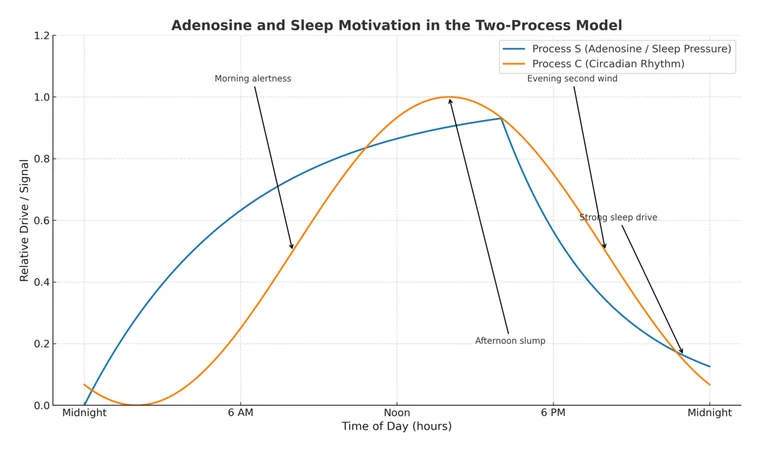
Sleep paralysis clusters when sleep is short and irregular. The two systems that govern sleep fall out of sync when you are deprived or off-schedule — which is when the REM-versus-wake mistiming happens. Rocxie · CC BY-SA 4.0 · Wikimedia Commons
When to see a doctor
Occasional sleep paralysis is common and benign. Talk to a doctor if it is frequent and distressing, if it is wrecking your sleep or making you genuinely afraid to fall asleep, or if it comes alongside sudden daytime sleep attacks or episodes of muscle weakness triggered by strong emotion — that particular combination can point to narcolepsy and deserves assessment.
Where SleepTrace fits
Sleep paralysis feeds on broken, short, irregular sleep — precisely the thing you cannot judge from the inside. SleepTrace maps your sleep stages from a night of audio on your iPhone and trends them, so you can see whether your episodes track with disrupted nights, and watch them fade as your sleep steadies. Understanding the mechanism removes the fear; seeing your sleep improve removes the trigger.
Frequently asked questions
It is a hallucination, not a real presence. During sleep paralysis your mind wakes before REM muscle-paralysis switches off, so you are conscious but frozen and still partly dreaming. The brain's threat system, shallow REM breathing and raw fear combine to generate a sensed 'intruder' — reported in strikingly similar form across every culture.
Remind yourself it is harmless and will pass within seconds to a couple of minutes, and try to move something small — a finger, a toe, your eyes — or focus on slow breathing. To prevent episodes, prioritise regular, sufficient sleep, avoid sleeping on your back, and manage stress.
References
Javaid A, Jan R, Khan A, Farhan K, et al. Characteristics of sleep paralysis and its association with PTSD, stress and other factors. Public Health Chall (2026). Europe PMC
SleepTrace is a wellness app, not a medical device. This article is general information, not medical advice. If your symptoms are frequent, severe or worrying, please talk to a doctor.
Hear your own night. SleepTrace turns a night of audio into your sleep phases, the sounds you made, and how it all trends — no wearable, just the iPhone on your nightstand. Download on the App Store →