Melatonin is a sleep-signalling hormone, not a sedative: it tells your brain clock that evening has arrived. It helps most when the clock is genuinely off — jet lag, shift work, delayed sleep phase — and the evidence for it as a general sleep aid is modest. Dose matters far less than timing: typically 0.5–3 mg, taken 1–2 hours before the target bedtime (or at the destination bedtime for jet lag), works as well or better than 10 mg. Lower doses, earlier timing, and treating it as a short-term signal rather than a nightly crutch is the evidence-based pattern.
Ask anyone why they take melatonin and the answer is almost always the same: "to help me sleep." It is the most popular sleep supplement in the world, and it comes with a confusing shelf of options — gummies, tablets, 3 mg, 5 mg, 10 mg. But there is one fact that changes how you should think about all of it: melatonin is not a sedative. It is not a sleeping pill, and it will not knock you out. Melatonin is a signal — a hormone your brain already produces to tell your body clock that evening has arrived. Understanding that one sentence clears up most of the confusion about dose, timing, and whether it will work for you.
If your problem is jet lag specifically, our jet lag and circadian rhythm guide covers the reset strategy in detail. This article is the general one: how much melatonin for sleep, when to take it, and what the evidence actually says.
Melatonin for sleep: what it actually does
Your body produces melatonin on a schedule. As light fades, your pineal gland releases it, and rising melatonin tells your brain clock it is night — it lowers the alertness signal and widens the window in which sleep can happen. That is why bright light in the evening suppresses melatonin and delays sleep, and why darkness helps sleep come on. The full biology is in the Wikipedia article on melatonin.
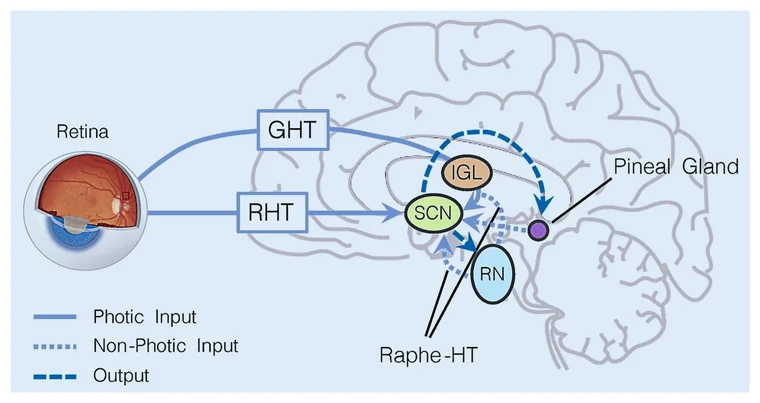
The supplement does not make you sleepy like a drug does. It nudges your clock toward an earlier "evening" — which is why it shines when the clock is genuinely wrong (jet lag, shift work, staying up too late) and why it does so little when your problem is a racing mind in a perfectly timed clock. That distinction — clock problem versus arousal problem — predicts better than dose whether melatonin will help you.
How much melatonin for sleep: the low-dose surprise
The most common mistake is taking too much. Retail bottles push 5 and 10 mg, and the logic seems obvious — more hormone, more sleep. But the evidence points the other way. Typical effective doses are 0.5–3 mg, and for clock resetting, low doses (around 0.5–1 mg) work at least as well as higher ones. Melatonin's effect on the clock follows a bell curve: physiological amounts do the signalling, and big doses mainly add side effects — vivid dreams, grogginess the next morning, and sometimes a paradoxical "hangover" that feels like worse sleep.
If you are deciding on a dose: start low and early. Begin at around 1 mg (or the smallest dose your product offers), taken at the right time, and only move up if the timing strategy alone does nothing after a few days. A high dose of melatonin for sleep is rarely the answer — and never the first move.
When to take melatonin for sleep
Timing beats dose. Because melatonin is a clock signal, when you take it tells your body clock what time you want it to think it is. The general rules:
- Take it 1–2 hours before your target bedtime. This mimics the natural evening rise and lets the signal build.
- For jet lag, time it to the destination. Take melatonin at the destination's bedtime (not your departure bedtime) for a few nights after arrival — our jet lag guide gives the full plan.
- Keep it short. It is a reset tool, not a nightly habit. A week or two is reasonable; nightly long-term use is where the picture gets murkier and where a doctor's input matters.
- Combine with light. Melatonin and light work as a pair — dim light in the evening, bright light in the morning. Taking melatonin while sitting in a bright room at midnight is signalling both "night" and "day" at once.
Who should be careful with melatonin
Melatonin is not a food, and "natural" does not mean "nothing to think about." Be cautious or skip it if you are pregnant or breastfeeding, have an autoimmune condition, take blood-thinning or blood-pressure medication, or have epilepsy — the interactions are real even if rare. And if you are giving it to a child, that is a conversation with a pediatrician, not a shelf decision: childhood sleep problems usually need a behaviour fix, not a hormone. For most healthy adults, short-term use at low doses is safe — but it should not be masking an underlying issue like untreated sleep apnea or a week-long sleep debt.
Why timing and dose beat the bottle
The takeaway that makes all the options simpler: melatonin for sleep is a timing tool. If you fix the timing — take a low dose, an hour or two before bed, in dim light, for a short run — you get most of the benefit available from the supplement. If you ignore timing and chase a high dose, you get the side effects without the benefit. And if your sleep problem is anxiety, a racing mind, or a broken night rather than a wandering clock, melatonin is likely to disappoint — that is the moment to look at what is actually keeping you awake rather than adding more of the signal your clock does not need.
Where SleepTrace fits
The cleanest way to know if melatonin is helping is to look at your actual night, not your feeling about it. SleepTrace records your sleep on your iPhone and maps the sounds to your sleep stages, so you can compare nights with and without the supplement — sleep latency, fragmentation, and how refreshed you genuinely are. Run a few nights, change the dose or timing, and let the data decide whether the supplement is earning its place in your routine.
Frequently asked questions
Melatonin is a sleep-signalling hormone, not a sedative — it tells your brain clock that evening has arrived. It helps most with sleep timing issues, like falling asleep earlier or adjusting to a new schedule, rather than forcing deep sleep.
For most adults the effective dose is surprisingly low — around 1–3mg, not the 5–10mg found in many products. Larger doses add side effects without more benefit.
About 1–2 hours before your target bedtime, and consistently at the same time. Timing matters as much as dose: taken too late it can shift your clock in the wrong direction.
SleepTrace is a wellness app, not a medical device. This article is general information, not medical advice. If your symptoms are frequent, severe or worrying, please talk to a doctor.
Hear your own night. SleepTrace turns a night of audio into your sleep phases, the sounds you made, and how it all trends — no wearable, just the iPhone on your nightstand. Download on the App Store →