Your circadian rhythm is an internal, roughly-24-hour clock driven by light that tells your body when to be alert and when to sleep. Jet lag happens when that clock is out of step with the local day after crossing time zones; the spring-forward time change does the same thing in miniature. The rules for resetting it are the same in both cases: bright light in the morning pushes the clock earlier, bright light in the evening pushes it later, and steady, consistent sleep and wake times (plus melatonin at the right moment for travel) are the practical tools. Most people adapt at roughly one time zone per day, eastbound a little harder than westbound.
If you've ever crossed three time zones and felt like a different species, or spent a groggy week after the clocks went forward, you already know jet lag — you just may not know what it actually is. It's not tiredness from travel, and it's not a mood. It's a mechanical mismatch: your internal clock and the outside world are telling your body different times, and your body can only obey one of them.
What jet lag means: your circadian rhythm, explained
A circadian rhythm is a roughly 24-hour biological cycle — in sleep, alertness, body temperature, digestion, hormone release — that runs inside nearly every living thing, driven by a master clock in the brain. When that rhythm leaves your time zone behind, you have jet lag — the Wikipedia article on jet lag digs into the mismatch. The word comes from the Latin circa (about) and diem (day): about a day. Left entirely alone in constant darkness, the human clock runs slightly long — around 24.2 hours — which is why it needs resetting each day.
The reset mechanism is light. Light hits your retina, and the signal travels to the master clock, which uses it to align your internal rhythm to the outside world. Bright light in the morning tells the clock to start the day — advancing it earlier. Bright light in the evening tells it to stay up — delaying it later. That's the entire lever that jet-lag advice hangs on, and it's the reason your phone in a dark bedroom is such a potent (and often unwanted) time cue.
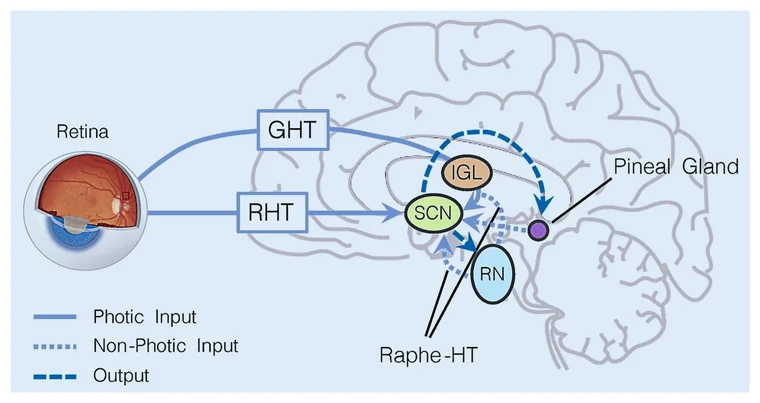
Why jet lag happens — and why east is worse
Jet lag is what you get when your internal clock is set to home, but the sun at your destination says something else. Your body still thinks it's 2 a.m. and wants sleep; the destination says it's 10 a.m. and the meeting is starting. Your internal clock can't adjust instantly — it moves at roughly one time zone per day, and it's asymmetric: it's easier for most people to stay up later (flying west) than to go to bed earlier (flying east). Flying east crosses more time zones against your natural drift, which is why red-eyes from the US to Europe leave people wrecked for days.
The mismatch does more than make you sleepy at the wrong time. It's a full-body desynchronization — appetite arrives at odd hours, mood sags, focus blurs, and even your digestion runs on the wrong schedule. That's all normal, temporary, and, for most travelers, self-limiting.
The time-change hangover: spring forward
The annual 'spring forward' is jet lag in miniature — the same clock, shifted by one hour overnight instead of several zones. For most people it's a few groggy days; research has repeatedly found small, short-lived bumps in accidents and missed sleep in the days right after. The same reset rules apply, just faster: strong morning light after the change, and going to bed at your new (early) bedtime even if you don't feel tired yet. It's a useful real-world reminder that even a one-hour shift is real — and a window into how much a constant mismatch matters when it becomes chronic.
Jet lag and a time change are the same problem at different scales: your clock says one time, the world says another. The lever is light, and the direction matters.
How to reset it — the rules that actually work
The evidence points to a short list of tools that matter, in rough order of power:
- Light, timed in the right direction. For jet lag going east, get bright light in the late morning and afternoon, and avoid it in the evening. Going west, seek bright light in the early-to-mid evening, and avoid it in the morning. This is the single strongest lever.
- Melatonin, at the right moment — not just any time. A Cochrane review found melatonin taken near the destination's target bedtime reduces jet lag, best when crossing five or more time zones and especially eastward. Timing is everything: at the wrong time of day it can delay adaptation instead of helping. It's worth a pharmacist or doctor conversation, not a free-for-all — our general guide to how much melatonin to take and when covers the dose and timing basics.
- Shift your clock before you travel. For a few days before an eastbound trip, gradually move your sleep and wake times (and light exposure) toward destination time.
- Anchor to local time immediately. Eat, sleep, and get daylight on destination time as soon as you land — even if you're not tired yet. One long nap may feel great and cost you two days of adaptation.
- Skip the caffeine-after-noon and the alcohol at bedtime; both pull your sleep in the wrong direction while you're trying to re-sync.
When it's not just jet lag
If your sleep and wake times have drifted for weeks or months — not after a flight or a time change, but as a standing pattern — that's not jet lag, that's a shifted schedule, and the same light rules apply, just as a daily habit rather than a recovery plan. And if you're perpetually exhausted despite a consistent schedule, that's a signal that something else is going on — snoring, breathing pauses, or a sleep disorder are the things worth ruling out before blaming your clock. Shift work deserves a mention too: working nights and sleeping days is chronic jet lag, and it's genuinely harder on health, so it deserves actual protection (good blackout, consistent sleep windows, light management) rather than just 'trying to cope'.
Where SleepTrace fits
SleepTrace shows you your real sleep architecture across nights, so you can watch your rhythm drift — and watch it come back as you apply the light rules or recover from a trip. It's the difference between guessing you slept badly and seeing the pattern: falling asleep later each night, waking in the small hours, deep sleep shrinking. And it does it from the sound of your night alone, with no wearable — useful on a trip where the last thing you packed was a sleep tracker. If chronic tiredness turns out to be the real issue, is snoring bad? is a good next step.
Frequently asked questions
Jet lag is the temporary mismatch between your internal body clock and the local day-night cycle after crossing time zones quickly. Your brain still runs on 'home time' while your destination runs on local time, and until light exposure slowly shifts your clock, your body wants to sleep, eat and be alert at the wrong hours. It fades as your clock re-syncs — roughly one time zone per day, faster going west than east.
Light is the master lever: bright light in the morning pushes your clock earlier, bright light in the evening pushes it later — so use it in the direction you want to move. Add a fixed wake time, anchor meals to that schedule, avoid evening light (especially screens) when trying to sleep earlier, and for travel, melatonin taken near the destination's bedtime can help, especially on eastward trips of five-plus time zones. It's a gradual nudge, not a switch.
A persistent 3 a.m. wake-up isn't jet lag — that's a short-term time-zone effect. Regular early-morning waking is more often a stable (if unhelpful) sleep pattern, driven by an early body clock, stress-driven arousals, or light leaking into the room. The standard fixes are the same as resetting any rhythm: consistent wake time, morning light, dim evenings, and cutting caffeine and alcohol. If it persists with daytime exhaustion, it's worth looking at whether anything fragments your sleep — like snoring.
References
- Herxheimer A, Petrie KJ. Melatonin for the prevention and treatment of jet lag. Cochrane Database Syst Rev (2002). Europe PMC
- Epistemonikos Group. Is melatonin useful for jet lag? A meta-analysis of four systematic reviews and 11 randomized trials. Medwave (2015). Europe PMC
SleepTrace is a wellness app, not a medical device. This article is general information, not medical advice. If your symptoms are frequent, severe or worrying, please talk to a doctor.
Hear your own night. SleepTrace turns a night of audio into your sleep phases, the sounds you made, and how it all trends — no wearable, just the iPhone on your nightstand. Download on the App Store →