How sleep works, in plain language.
Sleep phases, deep sleep, napping, the body clock and more, every "how does sleep work?" question we have answered, as the question you are actually asking.
The two things that decide when you feel sleepy
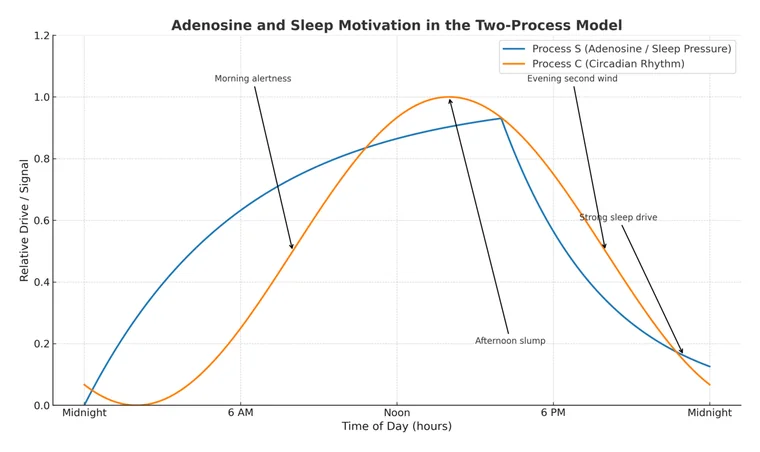
Almost everything about sleep gets easier to understand once you know that two separate systems are running at the same time, and that they do not always agree.
The first is sleep pressure. From the moment you wake up, a molecule called adenosine builds up in the brain. The longer you are awake, the more of it accumulates, and the heavier your eyelids get. Sleep is what clears it, which is why the pressure is at its lowest right after a full night and highest late in the evening. Caffeine does not remove adenosine; it blocks the receptors it docks onto, which is why the tiredness arrives all at once when the caffeine wears off.
The second is your body clock, an internal roughly-24-hour rhythm that runs whether you are tired or not. It is what makes you alert mid-morning even after a bad night, what produces the well-known afternoon dip, and what gives many people a second wind in the evening just when sleep pressure is at its peak.
You fall asleep easily when both point the same way: high sleep pressure and a body clock that has entered its night phase. Most sleep problems are a disagreement between the two, jet lag, shift work, a long late nap, or a weekend that shifts your clock by two hours and leaves Monday morning feeling like the middle of the night.
What a night actually looks like
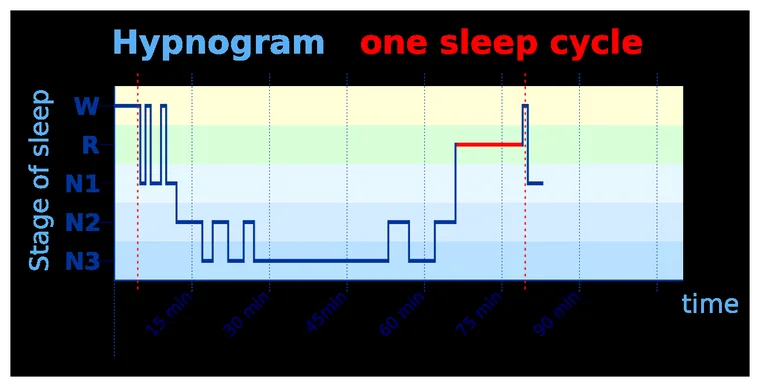
Sleep is not one state you sink into and climb out of. It runs in cycles of roughly 90 minutes, and each cycle contains a different mix:
- Light sleep (N1 and N2): the largest share of the night, and the phase people most often mistake for being awake.
- Deep sleep (N3): the large slow waves, hardest to be woken from, and almost entirely concentrated in the first few hours.
- REM sleep: the brain nearly as active as when awake, the body's muscles switched off, and the vivid, tellable dreams. REM blocks get longer as the night goes on, so most REM sits in the second half.
That front-loading of deep sleep and back-loading of REM is the single most useful fact on this page. It means cutting an hour off the start of your night costs you mostly deep sleep, and cutting an hour off the end costs you mostly REM. It also explains why you so often wake up mid-dream, and why a late night feels physically different from an early alarm.
Brief awakenings are part of a normal night too. Everyone has them; most are never remembered.
Why "eight hours" is the wrong target
Eight hours is an average, not a prescription, and the healthy range around it is wide. What actually matters is whether you wake up able to function without needing to top yourself up all day, and whether the hours you do spend asleep are continuous. Six uninterrupted hours can leave you in better shape than eight hours broken by fifty awakenings you never noticed, which is exactly what untreated breathing problems do.
This is why a number on a screen (hours slept, or a single score out of 100) is a poor summary. The useful question is not "how long", but "how continuous, and what interrupted it".
Why one night tells you almost nothing
Nights vary a great deal, even in healthy people, and even from one night to the next. A late meal, a glass of wine, a warm room, a stressful day, which side you slept on, all of them shift the picture. Any single measurement, whether from a watch, an app or even a sleep laboratory, is one sample from a noisy series.
So treat a single unusual night as noise. A pattern that holds over two or three weeks is a signal. That is the only sound way to read any sleep data, including ours.
Every question, answered
The questions below are the ones people actually type, grouped by what they are really about.
Sleep science
9Wearables
1Foundation
1See how your own sleep works. SleepTrace records your night and maps your real sleep stages, so you can see your deep sleep, REM and wake-ups instead of reading about averages. Get it for iPhone or Android →