REM sleep behavior disorder treatment has three stages, and the first one is not medical. The American Academy of Sleep Medicine's 2023 guideline opens with a good-practice statement that securing the sleeping environment is critically important: remove weapons and anything that could injure if thrown, move or pad sharp furniture and the headboard, put a soft mat beside the bed, and where episodes are severe, sleep separately or at minimum put a pillow between you and your partner. Only after that do medications come in, and both of the main ones carry a conditional recommendation, which in guideline language means the evidence is not strong. Immediate-release melatonin is usually tried first because it is better tolerated; clonazepam, a prescription benzodiazepine, has the longer clinical track record and the more measurable effect on muscle activity in sleep. Pramipexole and transdermal rivastigmine are also conditionally suggested for specific situations, deep brain stimulation is suggested against, and if a drug caused the RBD in the first place, the suggestion is to stop that drug. Success is measured as fewer injuries and calmer nights, not as a cure.
Search this topic and you get specialist literature. The American Academy of Sleep Medicine guideline, a 40-page systematic review, journal abstracts, a physician directory, a conference video. All accurate, none of it written for the person sitting on the edge of the bed at 7 a.m. wondering what happens now.
So here is the same information in the order it actually gets used in a clinic. The overview of the condition itself is in REM sleep behavior disorder; the general clinical picture is also summarized on Wikipedia's page on rapid eye movement sleep behavior disorder. This page is about what gets done.
REM sleep behavior disorder treatment starts with the room, not a pill
The AASM's 2023 clinical practice guideline does something unusual: before it lists a single drug, it issues a good-practice statement based on expert consensus, and states that implementing it is necessary for appropriate and effective management. The statement is about furniture. It says it is critically important to help patients maintain a safe sleeping environment, that removing bedside weapons or objects that could injure if thrown or wielded at a bed partner is of paramount importance, that sharp furniture such as nightstands should be moved away or have its edges and the headboard padded, that a soft carpet, rug or mat should go next to the bed to reduce injuries from falls, and that patients with severe, uncontrolled RBD should sleep separately from their partners — or at minimum place a pillow between them.
That is the strongest language in the entire guideline, and it applies to a task that costs an afternoon. There is a good reason for the emphasis. When one sleep center surveyed its RBD patients, 55% of those who answered reported an injury, most to themselves, around one in nine needed medical treatment, and two had subdural hematomas. Crucially, how often the episodes happened did not predict whether someone got hurt. You cannot wait for a pattern to justify the padding.
Then melatonin, usually
Once the room is safe, medication is discussed. For isolated RBD in adults, the AASM suggests immediate-release melatonin versus no treatment — and every one of the guideline's drug recommendations, including this one, is graded conditional. In guideline language that means clinicians should weigh it against the individual's circumstances rather than apply it by default, and it reflects evidence that is thin rather than conclusive. The underlying systematic review screened 4,690 studies and found 148 with usable data across 45 interventions, which tells you how scattered this field is.
Melatonin is usually tried first anyway, for a practical reason rather than a triumphant one: it is well tolerated, it interacts with very little, and a large share of people with RBD are over 65 and already taking several other things. Note the wording, though — immediate-release. Prolonged-release melatonin is a different product and has not performed the same way in trials. The full evidence picture, including the trial that found nothing at all, is in melatonin for REM sleep behavior disorder.
Then clonazepam
Clonazepam is also conditionally suggested for isolated RBD. It is a prescription benzodiazepine, it has been used for this since the 1980s, and among clinicians it has a reputation for working that is older than most of the evidence for it.
One head-to-head trial gives a useful sense of the trade. Thirty-four people with polysomnography-confirmed isolated RBD were randomized to either clonazepam or prolonged-release melatonin for four weeks. Visual scoring of REM sleep without atonia improved after clonazepam and not after the melatonin; people on clonazepam tended to report greater global improvement, though that difference did not reach statistical significance. But the melatonin group had less daytime sleepiness and fewer insomnia symptoms, and the clonazepam group had increased depressive symptoms. That is not a winner and a loser. That is a choice with a cost on both sides, which is exactly why it belongs to a doctor who knows the rest of your history. What clonazepam does, and what to ask before starting it, is covered in clonazepam for REM sleep behavior disorder.
The rest of the list, and the one thing suggested against
The guideline covers more than two drugs, and a few of its other recommendations matter for specific people.
- Pramipexole. Conditionally suggested for isolated RBD in adults. It is a dopamine agonist better known in Parkinson's disease and restless legs, and it is an option when the first two do not fit.
- Transdermal rivastigmine. Conditionally suggested for isolated RBD in adults who also have mild cognitive impairment, and separately for RBD secondary to Parkinson's disease. A patch, not a tablet.
- Drug-induced RBD: stop the drug. Where a medication caused it, the guideline suggests discontinuation over continuation. Antidepressants are the common trigger. This is a prescriber's decision — stopping an antidepressant abruptly on your own is its own hazard.
- Deep brain stimulation is suggested against as a treatment for RBD secondary to a medical condition. Worth knowing if someone with Parkinson's is weighing DBS: whatever else it may be for, it is not for this.
Do not self-medicate this one. Over-the-counter melatonin looks harmless, but starting it yourself for suspected dream enactment skips the part that actually matters — a sleep study that confirms what is happening and a neurological baseline you will want on record later. Go back to the doctor promptly if episodes get more frequent or violent despite treatment, if anyone is injured, if daytime sleepiness or unsteadiness appears after starting a drug, or if new symptoms show up such as a tremor, a changed sense of smell, fainting on standing or memory slips. And never treat a partner's dream enactment by restraining them — people have been badly hurt that way. Make the room safe and get it assessed.
What counts as it working
Set the target correctly or you will feel like nothing is happening. The goal is not a silent, motionless night. It is fewer episodes, less force in the ones that remain, and nobody getting hurt. Most trials in this area measure something in that family — global impression of improvement, diary counts of incidents, or the amount of muscle activity during REM sleep on a repeat sleep study — rather than a cure.
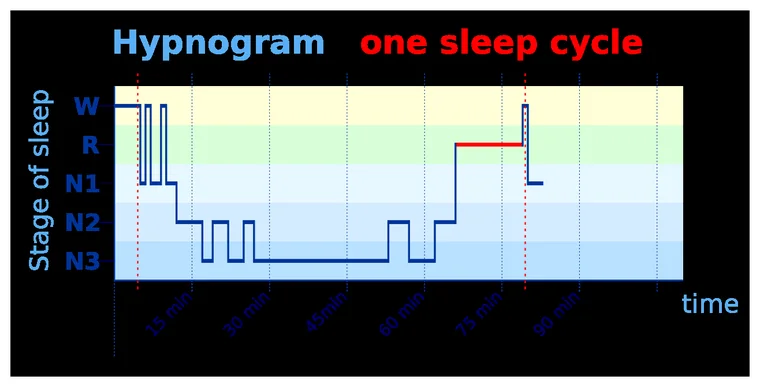
In practice the most useful evidence is the one you collect. A four-line note each morning — did anything happen, roughly what time, did anyone get hurt, how you felt on waking — turns a vague sense of "maybe a bit better" into something a clinician can act on at the next appointment. Bed partners are the best reporters here; people who sleep alone are, by definition, the worst.
Where SleepTrace fits
SleepTrace records your night with an iPhone and puts the sounds next to your sleep stages, which for RBD means the treatment question becomes answerable instead of theoretical: were there fewer loud events this month than last, and are they still landing at 4 a.m.? That is a timeline you can show a doctor. It does not measure muscle tone, it cannot tell dream enactment from any other movement, and it is not part of the diagnosis. For what a night recording can and cannot resolve, see how to record yourself sleeping.
Frequently asked questions
Making the bedroom safe, before any drug. The AASM's 2023 guideline puts this ahead of its medication recommendations as a good-practice statement, on the grounds that the injuries are the immediate danger. Among medications, immediate-release melatonin and clonazepam are both conditionally suggested for isolated RBD in adults, and which one comes first is usually decided by the person's other medications, age and fall risk rather than by a ranking of effectiveness.
Not currently. Treatment reduces the frequency and force of the episodes and prevents injuries; it does not restore normal REM muscle paralysis permanently, and it does not change what is causing the failure in the first place. That sounds bleak but is less so in practice: a large share of people get to a point where nobody is getting hurt and both partners sleep in the same bed again, which is what the treatment is for.
The main consequence is injury, to the sleeper or the person next to them. In one sleep-center survey of RBD patients, 55% of respondents reported an injury and around one in nine needed medical treatment for it. Untreated RBD also frequently ends up with couples sleeping apart. Leaving it alone does not make the underlying process go away, and it removes the chance to have a neurological baseline on record.
There is no evidence that any current RBD treatment alters that risk. Melatonin and clonazepam act on the symptom, not on the underlying process. This is an active research area and one reason specialists encourage people with isolated RBD to join long-term cohort studies, since those cohorts are where any future neuroprotective treatment will be tested.
References
- Howell M, Avidan AY, Foldvary-Schaefer N, Malkani RG, During EH, Roland JP, McCarter SJ, Zak RS, Carandang G, Kazmi U, Ramar K. Management of REM sleep behavior disorder: an American Academy of Sleep Medicine clinical practice guideline.. J Clin Sleep Med (2023). Europe PMC
- Howell M, Avidan AY, Foldvary-Schaefer N, Malkani RG, During EH, Roland JP, McCarter SJ, Zak RS, Carandang G, Kazmi U, Ramar K. Management of REM sleep behavior disorder: an American Academy of Sleep Medicine systematic review, meta-analysis, and GRADE assessment.. J Clin Sleep Med (2023). Europe PMC
- Byun JI, Shin YY, Seong YA, Yoon SM, Hwang KJ, Jung YJ, Cha KS, Jung KY, Shin WC. Comparative efficacy of prolonged-release melatonin versus clonazepam for isolated rapid eye movement sleep behavior disorder.. Sleep Breath (2023). Europe PMC
- McCarter SJ, St Louis EK, Boswell CL, Dueffert LG, Slocumb N, Boeve BF, Silber MH, Olson EJ, Morgenthaler TI, Tippmann-Peikert M. Factors associated with injury in REM sleep behavior disorder.. Sleep Med (2014). Europe PMC
SleepTrace is a wellness app, not a medical device. This article is general information, not medical advice. If your symptoms are frequent, severe or worrying, please talk to a doctor.
Hear your own night. SleepTrace turns a night of audio into your sleep phases, the sounds you made, and how it all trends — no wearable, just the iPhone on your nightstand. Download on the App Store →