REM sleep behavior disorder (RBD) is dream enactment: during REM sleep the brain normally paralyzes almost every muscle below the neck, and in RBD that paralysis fails, so the body carries out the movements of the dream. Episodes come from REM sleep, which means they cluster in the second half of the night, the movements match a dream the person can usually describe on waking, and the dreams are often confrontational. That is what separates RBD from sleepwalking and night terrors, which come out of deep NREM sleep in the first hours and leave little or no memory. Injuries are common — in one survey of RBD patients, 55% of those who responded reported an injury to themselves or their bed partner. Diagnosis requires an overnight sleep study showing REM sleep without the normal muscle atonia, because dream enactment alone is not enough. It matters: isolated RBD in adults over 50 is one of the strongest known early signs of Parkinson's disease and related conditions, so it should be assessed by a doctor rather than treated as a quirk.
A woman wakes up because her husband has hit her in the face. He is still asleep. Ten seconds later he surfaces, confused and apologetic, and tells her he was pulling someone off a fence. He is not violent, not drunk and not dreaming more than anybody else. The muscles that should have been switched off while he dreamed were switched on.
That is the whole of it. Every other detail of this condition follows from one failed switch. The medical name is REM sleep behavior disorder, usually shortened to RBD, and it is the most physically consequential of the common parasomnias — and the one most often misfiled as "he's a restless sleeper" for years before anyone looks at it properly. You can read the clinical overview on Wikipedia's page on rapid eye movement sleep behavior disorder; what follows is the version written for the person who just got hit, or did the hitting.
What REM sleep behavior disorder actually is
Every night, several times, your brain enters REM sleep. Dreams get long, narrative and vivid, the eyes flick around behind closed lids, and the brainstem sends a signal that does something remarkable: it paralyzes you. Almost every voluntary muscle below the neck goes limp. The diaphragm keeps working, the eye muscles keep working, everything else is taken offline. Sleep researchers call this REM atonia, and its job is obvious once you name it — it stops you from performing the dream.
In RBD, that signal is weak or absent. The dream still runs. The motor commands still get generated. But nothing blocks them, so they reach the muscles and the body does what the dream says. The person is not awake, not confused and not hallucinating; they are accurately executing a scene that exists only in their head.
Three things follow from this, and they are the fingerprints clinicians look for. First, episodes come from REM sleep, and REM is heavily weighted toward the second half of the night — so these events tend to happen at 3 a.m., not at 11:30 p.m. Second, the movement matches a story, because it is one; wake the person and they can usually tell you the plot. Third, the dreams skew confrontational — being chased, attacked, or defending someone — which is why the movements are so often punches, kicks and lunges rather than gentle shuffling.
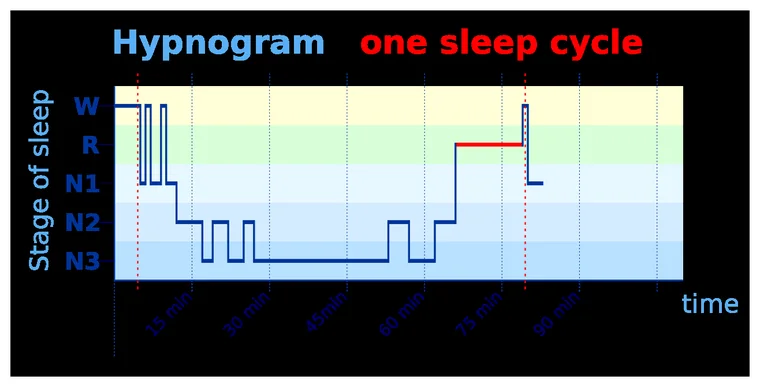
RBD, sleepwalking and night terrors: what actually separates them
These get lumped together as "doing things in your sleep", and the lumping is the reason so many people are told the wrong thing. They come from opposite ends of the night and opposite states of the brain. Three questions usually settle it.
- When did it happen? Deep NREM sleep is front-loaded, so sleepwalking and night terrors concentrate in the first two or three hours. REM is back-loaded, so RBD concentrates in the last few.
- What do they remember? After a night terror or a sleepwalking episode, most people remember nothing, or at most a single frozen image. After an RBD episode, people typically wake straight into clear recall of a dream whose action matches what their body just did.
- Did they leave the bed? Sleepwalkers walk — down stairs, to the kitchen, out the front door — with eyes open. RBD generally stays at the bed: punching, kicking, sitting up, sometimes falling out. Eyes stay shut.
None of these is absolute on its own, which is precisely why the diagnosis is not made from a story. But together they are a very good filter, and they explain why a bed partner's account is worth more than any questionnaire.
How the diagnosis is actually made
Dream enactment on its own is not RBD, and this is the single most misunderstood point on the internet about this condition. When researchers put polysomnography on 1,075 Korean adults aged 50 to 80 and sorted them by symptoms and muscle recordings, more people turned out to have one half of the picture than had the condition itself — acting out dreams without the muscle finding was more than twice as common as RBD. Half a picture is not a diagnosis, and the two halves lead to different conversations. Those prevalence figures are set out in full in REM sleep behavior disorder and Parkinson's disease, where they matter most.
So the diagnosis requires an overnight sleep study — video polysomnography — that records chin and limb muscle activity during REM sleep and shows that the atonia is genuinely absent. The video matters too: a technician watching the recording can see whether the movement is dream enactment or something else entirely, such as the limb jerks of a breathing disorder.
Before the sleep lab, screening is often startlingly simple. A multicenter study validated a single yes/no question about acting out dreams against polysomnography in 484 people and reported a sensitivity of 93.8% and a specificity of 87.2%. That is one question, and it performs about as well as much longer questionnaires. It is a screen, not a diagnosis — but it is a perfectly good reason to raise the subject with a doctor.
Why it is worth taking seriously
Two reasons, and they are different in kind.
The first is immediate and physical. Researchers at one sleep center surveyed their RBD patients about injuries; of the 53 who responded, 29 — 55% — reported an injury, 37.8% to themselves and 16.7% to their bed partner. About 11% had injuries serious enough to need medical treatment or hospital admission, including two subdural hematomas. These are not theoretical risks, and notably, how often the episodes happened did not predict injury. One bad night is enough.
The second is longer term, and it is the part nobody enjoys writing. In adults over 50, isolated RBD — meaning RBD with no other neurological diagnosis — is one of the strongest known early markers of Parkinson's disease, dementia with Lewy bodies and multiple system atrophy. This is real and it is well documented, and it is also widely misreported in a way that terrifies people unnecessarily. The numbers, the time frames and what they do and do not mean are laid out properly in REM sleep behavior disorder and Parkinson's disease. Read that one before you go looking at forums.
See a doctor rather than wait if you or your partner have been hurt during an episode, if you have jumped or fallen out of bed, if episodes are getting more frequent, or if dream enactment started after you began a new medication — antidepressants are the usual suspect and stopping them is a decision for the prescriber, not for you. Get assessed promptly, not eventually, if you are over 50 and the behavior is new: the American Academy of Sleep Medicine's 2023 guideline treats a safe sleeping environment as the non-negotiable first step, and that advice is worth nothing if nobody has looked at you yet. Never let a partner sleep beside untreated, injurious dream enactment on the assumption it will settle down.
What happens after the diagnosis
Less drama than most people expect. The first move is almost always environmental — padding, clearing, rearranging — and only then medication, usually melatonin or clonazepam. What each actually does, in what order, and what the evidence behind them is really worth, is covered in REM sleep behavior disorder treatment. There is also, for most people, a neurological baseline assessment so that changes over the following years can be measured against something rather than guessed at.
Where SleepTrace fits
SleepTrace records the sound of your night with an iPhone on the nightstand and lines it up against your sleep stages, so a 3 a.m. thud, shout or scuffle is something you can scroll back to and listen to rather than reconstruct from a bruise. For someone sleeping alone who suspects dream enactment, that is the difference between a suspicion and a set of timestamps to hand a doctor. It cannot diagnose RBD — the diagnosis needs muscle recordings in a lab, and nothing on a phone can substitute for that. If you want a wider picture of what a night recording does and does not show, start with how to record yourself sleeping.
Frequently asked questions
Timing, memory and what the body does. Sleepwalking rises out of deep NREM sleep, so it happens in the first hours after you go to bed, the person's eyes are open, they can walk around the house, and they usually remember nothing. RBD comes out of REM sleep, so it is weighted toward the second half of the night, the eyes stay closed, the person rarely leaves the immediate area of the bed, and they can often describe the dream that matches the movement within seconds of waking.
The behavior itself can be. Because the movements are driven by dream content that is often confrontational, they tend to be fast and forceful. In a survey of RBD patients at one sleep center, 55% of respondents reported an injury, most to themselves, and about one in nine had injuries needing medical treatment, including two subdural hematomas. The disorder is not painful or frightening in the way a nightmare is, but the bedroom around it needs to be made safe.
Yes, and it is common. The person acting out the dream is asleep; the one who notices is usually the bed partner. People who sleep alone often find out only from an injury they cannot explain, an object knocked off the nightstand, or a bruise. This is one of the few sleep problems where a second pair of eyes — or a recording — genuinely adds information you cannot get any other way.
In adults over 50, most isolated cases involve early degeneration in the brainstem circuits that produce REM paralysis, which is why RBD is linked to Parkinson's disease and related conditions. It can also be triggered by medication, particularly antidepressants, and it appears alongside narcolepsy. That is why the first step is a proper assessment rather than a guess: the answer changes what happens next.
References
- Postuma RB, Arnulf I, Hogl B, Iranzo A, Miyamoto T, Dauvilliers Y, Oertel W, Ju YE, Puligheddu M, Jennum P, Pelletier A, Wolfson C, Leu-Semenescu S, Frauscher B, Miyamoto M, Cochen De Cock V, Unger MM, Stiasny-Kolster K, Fantini ML, Montplaisir JY. A single-question screen for rapid eye movement sleep behavior disorder: a multicenter validation study.. Mov Disord (2012). Europe PMC
- Lee WJ, Baek SH, Im HJ, Lee SK, Yoon JE, Thomas RJ, Wing YK, Shin C, Yun CH. REM Sleep Behavior Disorder and Its Possible Prodromes in General Population: Prevalence, Polysomnography Findings, and Associated Factors.. Neurology (2023). Europe PMC
- McCarter SJ, St Louis EK, Boswell CL, Dueffert LG, Slocumb N, Boeve BF, Silber MH, Olson EJ, Morgenthaler TI, Tippmann-Peikert M. Factors associated with injury in REM sleep behavior disorder.. Sleep Med (2014). Europe PMC
- Howell M, Avidan AY, Foldvary-Schaefer N, Malkani RG, During EH, Roland JP, McCarter SJ, Zak RS, Carandang G, Kazmi U, Ramar K. Management of REM sleep behavior disorder: an American Academy of Sleep Medicine clinical practice guideline.. J Clin Sleep Med (2023). Europe PMC
SleepTrace is a wellness app, not a medical device. This article is general information, not medical advice. If your symptoms are frequent, severe or worrying, please talk to a doctor.
Hear your own night. SleepTrace turns a night of audio into your sleep phases, the sounds you made, and how it all trends — no wearable, just the iPhone on your nightstand. Download on the App Store →