REM sleep is usually quoted as 20-25% of the night, which on a seven-and-a-half-hour night is about 90 to 110 minutes. Carefully screened laboratory data run lower than the textbook range: in 100 healthy adults scored to AASM standards, median REM was 15.5% of sleep under age 30 and 10.3% over 60, with wide individual spread in both groups. REM is heavily back-loaded — the first REM period of the night can last only a few minutes while the last runs twenty or thirty — so it is the end of the night that carries it. Measured directly, healthy men restricted to three hours of sleep recorded 17.0% REM in a midnight-to-03:00 window against 25.7% in a 03:00-to-06:00 window, which is why cutting a night short at the alarm removes proportionally more REM than going to bed late does. Alcohol is the most reliable everyday REM suppressant: a meta-analysis of 27 studies found delayed REM onset and reduced REM duration starting at about two standard drinks, worsening with dose. Low REM is not just cosmetic — in two large cohorts, every 5% less REM was associated with a 13% higher mortality rate — but that is an observational association, and no consumer device measures REM accurately enough for one night's figure to mean anything.
Deep sleep gets the attention because it sounds like the important one. REM is the stage that quietly disappears, because of where it lives: not spread evenly through the night, but stacked into the hours immediately before your alarm. Which means the most common cause of low REM is not a disorder, a deficiency or a mattress. It is a six o'clock start. The Wikipedia overview of the sleep cycle shows the structure; this page is about the numbers and what moves them.
How much REM sleep do you need, in numbers
The question people type is "how much REM sleep do I need", and the honest answer is a percentage rather than a fixed number of hours, because REM is regulated as a share of the night and the share is what every study reports.
The figure in circulation is 20-25% of total sleep. On a 450-minute night that is 90 to 113 minutes — an hour and a half to just under two. It is a reasonable rule of thumb, and it is what your app is implicitly comparing you against.
Measured data in carefully screened healthy people come out lower. In a study of 100 healthy sleepers aged 19 to 77, screened out of a representative population sample and scored to current American Academy of Sleep Medicine standards, median REM was 15.5% of sleep in the group aged 30 or under and 10.3% in the group over 60, with a wide spread: 7.5% to 23.6% in the younger group, 1.9% to 21.9% in the older one.
Both figures are real, and the gap is instructive. The 20-25% range comes largely from textbook summaries and idealised young-adult samples; a single lab night in a screened population, with the first-night effect that comes with sleeping in a lab, produces less. If your tracker says 16% REM, you are not below normal — you are inside what a sleep laboratory recorded from healthy people. The age gradient in that same study, 15.5% down to 10.3%, is roughly a third of the REM share lost across an adult lifetime, and that decline is normal rather than a warning.
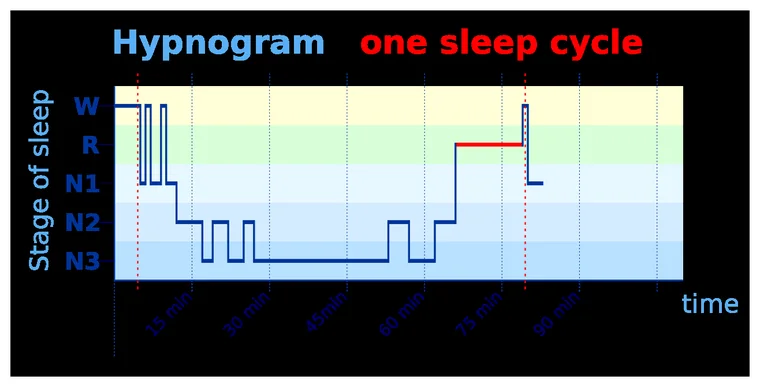
Why REM is back-loaded, and what waking early costs
Sleep pressure built up during the day is spent first, on deep sleep. As slow-wave activity decays, REM periods get progressively longer: the first may be a few minutes, the last twenty to thirty. That is normal architecture, not a deficiency.
It has been measured directly rather than just read off a chart. In a sleep-restriction study, healthy men were limited to three hours of sleep in two different windows, tested sequentially: midnight-03:00, and 03:00-06:00. After four days the earlier window produced 17.0% REM against 25.7% in the later one, and after one day latency to the first REM period was 78.8 minutes early versus 45.5 late. The last hours of the biological night really are REM territory.
One honest complication from the same study cuts against a simple "REM is what you need" reading: the men performed better on a psychomotor vigilance task after the earlier window — 249.8 milliseconds versus 272 — and the authors concluded that earlier-night sleep may be more beneficial for daytime vigilance. The cumulative decline in vigilance came from losing total sleep time, not from losing any specific stage. More REM did not mean sharper.
So the practical reading is narrow: for more REM, the lever is the morning end of the night. To feel alert, the lever is total sleep.
What REM is for, and what low REM is associated with
REM is when the brain runs at close to waking speed while the body is paralysed. It is the source of long, vivid, narrative dreams, and it is implicated in consolidating emotional and procedural memory.
The most striking finding about REM in adults is epidemiological rather than mechanistic. Researchers analysed two independent cohorts — 2,675 older men followed for a median of 12.1 years, and 1,386 middle-aged adults followed for a median of 20.8 years. Every 5% reduction in REM was associated with a 13% higher mortality rate after adjustment for demographic, sleep and health covariates, with similar results for cardiovascular and other non-cancer causes. People recording less than 15% REM had higher mortality than those at 15% or above across every outcome examined, and a random forest model identified REM as the sleep stage most strongly associated with survival. It replicated in the second cohort despite a younger sample, the inclusion of women and a longer follow-up.
That is easy to over-read. It is an observational association: low REM may be a marker of something else — early illness, medication, undiagnosed sleep apnea — rather than a cause. Nobody has shown that raising your REM percentage improves an outcome. What it does establish is that REM is not the decorative stage.
What cuts REM, and how to get it back
The list of things that reliably suppress REM is short and mostly within your control.
- Alcohol, at doses most people would call modest. A meta-analysis of 27 studies found delayed REM onset and reduced REM duration, dose-dependently: disruption appeared at 0.50 g per kilogram or less — roughly two standard drinks — and worsened with more. Falling asleep faster only appeared at about five drinks or more, and the reviewers note this likely worsens the REM disruption that follows.
- Cutting the night short. An alarm two hours early removes mostly REM.
- An irregular schedule. REM is tied to circadian phase, not just to how long you have been asleep, so shifting your sleep window scatters it. A fixed wake time is the most effective structural fix; how to fix your sleep schedule covers the method.
- Some medication. Many antidepressants, particularly SSRIs and SNRIs, suppress REM substantially — a conversation with the prescriber, never a reason to stop anything yourself.
- Untreated sleep apnea. Events cluster in REM because the airway muscles are at their most relaxed, and the resulting arousals cut REM periods short repeatedly.
There is a flip side that explains a common experience. When REM has been suppressed — after alcohol, after several short nights — the following nights often show a rebound, with REM arriving earlier and running longer. That is the unusually intense dreaming people report on the first alcohol-free night of the week: the system catching up, not a problem. If vivid dreaming is what brought you here, why are my dreams so vivid goes into it properly.
What your tracker's REM number is worth
Less than the display suggests. No wrist, ring or phone device sees brain waves; they infer stages from movement, pulse timing and sound, and stage classification is the weakest thing they do — two devices on one person on one night routinely produce different splits. That applies to SleepTrace too: our REM figure is a model's estimate, useful as a trend across weeks, not as a verdict on last night.
For what the stage actually is rather than what the bar says, deep sleep vs REM sets the two side by side, and how much deep sleep do you need covers the other half.
See a doctor rather than adjusting your tracker if low REM comes with any of the following. Loud snoring, witnessed pauses in breathing, or waking gasping or choking point to sleep apnea, which suppresses REM directly. Acting out dreams — shouting, punching, kicking or leaping from the bed, with a matching dream you can describe on waking — is dream enactment and needs a neurological assessment, especially over the age of 50. Falling asleep suddenly during the day, sleep paralysis, or dream-like hallucinations while falling asleep can point to narcolepsy. And if you take antidepressants, expect suppressed REM as an ordinary drug effect and discuss it with the prescriber rather than stopping. A REM percentage from a consumer device cannot diagnose or exclude any of these.
Where SleepTrace fits
We estimate REM from sound and movement with an iPhone on the nightstand — an estimate, on the same side of the line as every watch and ring, and we would rather say so than imply a precision we do not have.
What a microphone adds is the explanation rather than the number. REM is when the airway is most relaxed and when snoring and breathing events cluster, so a REM block that keeps breaking apart at 05:00 usually has an audible cause, and hearing it is more actionable than a percentage. To see how many full cycles your bedtime allows before the alarm, the sleep calculator works it out from your wake time.
Frequently asked questions
Between about 75 and 110 minutes is the usual answer for an adult sleeping seven to eight hours, based on the textbook range of 20-25% of total sleep. Carefully screened laboratory samples record less than that — a median of 15.5% under age 30 — so anything from roughly an hour upward on a full night is unremarkable. Because REM sits at the end of the night, the total depends far more on how long you sleep than on anything you do during the day.
Roughly one and a half to two hours on a full night, and proportionally less on a short one. The hour figure is the wrong unit to fix on, though: REM is regulated as a share of sleep, and the share is what the research reports. If you sleep five hours you will get substantially less than half the REM of an eight-hour night, because you are cutting off the part of the night where REM periods are longest.
Sleep longer at the end of the night, and remove the things that suppress it. Because REM periods lengthen toward morning, an extra 45 minutes before your alarm buys disproportionately more REM than an extra 45 minutes at bedtime. The most effective single change for most people is moving alcohol away from the evening: a meta-analysis found REM duration reduced and REM onset delayed from about two standard drinks upward, worsening with dose. Keeping a fixed wake time and treating untreated sleep apnea matter for the same reason.
Less than at 25, and that is normal. Median REM in screened healthy adults was 15.5% of sleep under age 30 and 10.3% over 60, so somewhere around an hour on a full night is typical in later life. This is also why the common worry about one hour of REM usually resolves itself: one hour after eight hours in bed is worth watching over a few weeks, but one hour after five and a half hours of sleep is arithmetic rather than a problem. Bear in mind too that consumer devices are poor at distinguishing sleep stages, so a single night's REM figure is one of the least reliable numbers your tracker produces.
References
- Mitterling T, Högl B, Schönwald SV, Hackner H, Gabelia D, Biermayr M, Frauscher B. Sleep and Respiration in 100 Healthy Caucasian Sleepers--A Polysomnographic Study According to American Academy of Sleep Medicine Standards.. Sleep (2015). Europe PMC
- Wu H, Stone WS, Hsi X, Zhuang J, Huang L, Yin Y, Zhang L, Zhao Z. Effects of different sleep restriction protocols on sleep architecture and daytime vigilance in healthy men.. Physiol Res (2010). Europe PMC
- Gardiner C, Weakley J, Burke LM, Roach GD, Sargent C, Maniar N, Huynh M, Miller DJ, Townshend A, Halson SL. The effect of alcohol on subsequent sleep in healthy adults: A systematic review and meta-analysis.. Sleep Med Rev (2025). Europe PMC
- Leary EB, Watson KT, Ancoli-Israel S, Redline S, Yaffe K, Ravelo LA, Peppard PE, Zou J, Goodman SN, Mignot E, Stone KL. Association of Rapid Eye Movement Sleep With Mortality in Middle-aged and Older Adults.. JAMA Neurol (2020). Europe PMC
SleepTrace is a wellness app, not a medical device. This article is general information, not medical advice. If your symptoms are frequent, severe or worrying, please talk to a doctor.
Hear your own night. SleepTrace turns a night of audio into your sleep phases, the sounds you made, and how it all trends — no wearable, just the iPhone on your nightstand. Download on the App Store →