Deep sleep and REM sleep are opposites in almost every respect. Deep sleep — stage N3, slow-wave sleep — comes first, concentrated in the two or three hours after you fall asleep; the EEG slows into large synchronised waves, heart rate and blood pressure fall to their nightly minimum, and you are very hard to wake. REM comes later and lengthens toward morning; the EEG looks close to waking, the eyes move, almost every muscle below the neck is paralysed, and this is where long narrative dreams happen. In 100 healthy adults scored to AASM standards, median deep sleep was 20.7% of the night under age 30 and 14.9% over 60, while REM ran 15.5% and 10.3% in the same groups. Because they sit at opposite ends of the night, cutting sleep short at the alarm removes mostly REM, while going to bed very late removes mostly deep sleep. No, deep sleep is not REM sleep — they are different stages, and the confusion is made worse by Apple Watch, which reports a third label called Core sleep for the lighter NREM stages between them. Neither stage is the important one: both are estimated rather than measured by any consumer device, so the useful reading is the trend over weeks, not one night's split.
Most sleep apps draw deep sleep and REM as two bars of different colours and leave it at that, which quietly suggests they are two flavours of the same thing. They are closer to opposites. One shuts the brain down into its slowest, most synchronised state; the other runs it at close to waking speed while paralysing the body so it cannot act on what it is doing.
Getting the difference straight is worth ten minutes, because it tells you what a particular bad night actually cost you.
Deep sleep vs REM: the short version
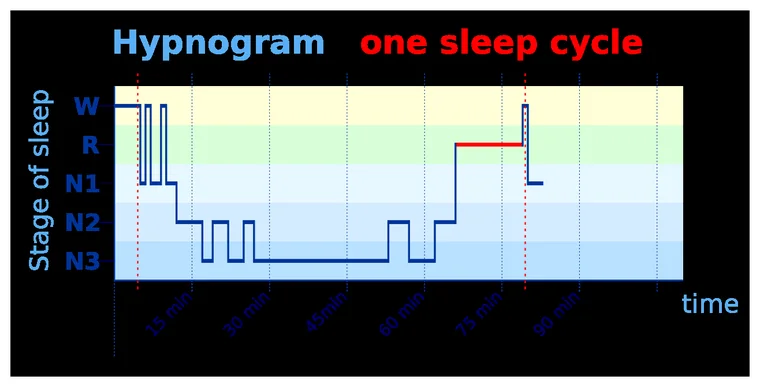
Sleep is scored into four states: N1 and N2 (light non-REM), N3 (deep, slow-wave), and REM. A night runs through them in cycles of roughly 90 minutes, but the mix inside those cycles changes dramatically from the beginning of the night to the end.
The measured proportions come from a study of 100 healthy sleepers aged 19 to 77, recorded for a full night and scored to current American Academy of Sleep Medicine standards. Median deep sleep was 20.7% of sleep in the under-30 group and 14.9% in the over-60 group. REM was 15.5% and 10.3% in the same two groups. Both stages shrink with age; the light N1 and N2 stages and time awake in bed expand to fill the gap.
Two things follow immediately. First, most of a normal night is neither deep sleep nor REM — light non-REM sleep is the majority of it, and that is not a defect. Second, the textbook figure of 20-25% REM that circulates online sits above what these carefully screened adults actually recorded on a laboratory night. Round numbers travel further than measured ones.
When each stage happens, and why that is the whole story
Deep sleep is front-loaded. Slow-wave activity is at its maximum in the first cycle and decays across the night, so the great majority of your N3 arrives in the two to three hours after you fall asleep. REM does the reverse: the first REM period of the night may last only a few minutes, and the last one before your alarm can run twenty or thirty.
That asymmetry has been measured directly rather than just inferred from charts. In a sleep-restriction study, healthy men were limited to three hours of sleep under two different schedules: one group window ran from midnight to 03:00, the other from 03:00 to 06:00. After four days the same men recorded 17.0% REM in the early window against 25.7% in the late one, and after one day their latency to the first REM period was 78.8 minutes early versus 45.5 minutes late. The late-night hours are simply REM-richer.
Practically, this is the most useful thing on this page. A night that starts three hours late costs you deep sleep. A night that ends three hours early costs you REM. Both are called "not enough sleep", and they are not the same injury.
Is deep sleep REM sleep? No, and here is why the question keeps coming up
Two habits of language cause this. The first is that everyday English uses "deep sleep" to mean "properly asleep", which includes REM. The second is that both stages get sold as the valuable ones, so people assume the valuable stage must be a single thing with two names.
On a sleep study they are almost unmistakable. Deep sleep shows large slow waves at under 4 Hz covering most of the recording, no eye movement, and steady muscle tone. REM shows low-amplitude mixed-frequency activity that resembles wakefulness, bursts of rapid eye movement, and a near-flat chin muscle trace because the brainstem has switched off almost every voluntary muscle below the neck. If you want the anatomical detail, the Wikipedia overview of rapid eye movement sleep is accurate and well sourced.
The paralysis is the detail people find most surprising, and it is not a curiosity. When it fails, the sleeper acts out the dream — that is REM sleep behavior disorder, and it is the clearest possible demonstration that REM and deep sleep are different machinery.
Core sleep vs deep sleep: Apple's third label
If you use an Apple Watch you have a fourth word to deal with. Apple's own support page states that you can view the time and percentage you spent "Awake or in REM, Core, or Deep sleep". Core is not a term from sleep medicine. It maps onto stages N1 and N2 — the lighter non-REM sleep that makes up the bulk of a normal night.
So the comparison people actually want is this: Core sleep is not a failure state, and it is not deep sleep. It is where sleep spindles occur, it typically occupies around half of the night in a healthy adult, and seeing a large Core block is not a sign that you slept badly. Reading Apple's labels as "REM and Deep are the good bars, Core is the filler" is the single most common misreading of that screen.
Other brands relabel the same thing differently — "light sleep" is the usual alternative — which is why two devices worn on the same night can produce percentage splits that look like they came from different people. They are not necessarily disagreeing about the physiology; sometimes they are drawing the same night with different boundaries.
What each stage is for, and which one matters more
Deep sleep is when the brain does its housekeeping. The most cited demonstration is a 2013 study in mice, in which natural sleep or anaesthesia was accompanied by a 60% increase in the space between brain cells, a striking rise in the exchange of cerebrospinal fluid with interstitial fluid, and a faster clearance rate of beta-amyloid. That work was done in mice and the human picture is less settled than headlines suggest, but it gave the restorative function of sleep a plausible physical mechanism for the first time.
REM has a harder-to-summarise job — memory consolidation, particularly emotional and procedural memory, and something like overnight emotional processing. What it also has is an unusually direct link to long-term outcomes. A study of two independent cohorts, 2,675 older men followed for a median of 12 years and 1,386 middle-aged adults followed for nearly 21, found a 13% higher mortality rate for every 5% reduction in REM sleep after adjustment, with similar results for cardiovascular and other causes. People with less than 15% REM had higher mortality than those with 15% or more, and a random forest model picked REM out as the sleep stage most strongly associated with survival.
That is an association in observational cohorts, not proof that raising your REM percentage extends your life — low REM may well be a marker of something else, such as undiagnosed illness or medication. It is still the strongest single argument against treating REM as the optional stage.
Which leaves the honest answer to "which is more important": you do not get to choose, so the question is academic. Both are regulated, both rebound when lost, and both are estimated rather than measured by everything you own.
Take it to a doctor rather than to an app if the stage split is not the real problem. Specifically: if you snore loudly, stop breathing, or wake gasping or choking, get assessed for sleep apnea — it shreds both stages and no amount of sleep hygiene fixes it. If you physically act out dreams, shout, punch, kick or leave the bed and can describe a matching dream afterwards, that is dream enactment and belongs in front of a neurologist or sleep physician, particularly over the age of 50. And if you sleep seven hours or more and are still exhausted every day, the cause is a medical question, not a tracking question. Stage percentages from a watch, ring or phone app cannot diagnose or exclude any of this.
Where SleepTrace fits
Everything above is scored from electrodes. SleepTrace is not: it estimates stages from sound and movement with an iPhone on the nightstand, which puts it in exactly the same category as the watches and rings — an estimate, useful as a trend, unreliable as a single night's verdict. We would rather say that clearly than sell you a percentage.
Where a microphone genuinely adds something is the part a stage chart cannot show: what happened. A REM block that keeps breaking up at 04:30 means something different if you can hear snoring, a partner, a dog or a truck underneath it. If you want the numbers for each stage on their own, start with how much deep sleep do you need and how much REM sleep do you need, or work backwards from your alarm with the sleep calculator.
Frequently asked questions
No. They are two different stages with almost nothing in common apart from both being sleep. Deep sleep is stage N3, part of non-REM sleep: slow brain waves, low heart rate, no eye movement, very hard to wake from. REM is a separate stage with fast brain activity close to waking, darting eye movements and near-total muscle paralysis. The confusion is understandable — both get called the deep or important part of sleep in everyday speech — but on a sleep study they look nothing alike.
Core sleep is Apple's label, not a scientific stage. Apple Watch reports four categories — Awake, REM, Core and Deep — and Core covers the lighter non-REM stages that sleep medicine calls N1 and N2. Deep is stage N3. So Core sleep is not shallow wasted time and it is not deep sleep either: it is the majority of a normal night, typically around half of it, and it is where sleep spindles happen.
Neither, and the question does not really have an answer, because you cannot trade one for the other. The body regulates both, prioritises deep sleep early and REM late, and rebounds on whichever one it was short of. The only practical version of the question is which one a given behaviour costs you: a late bedtime mostly costs deep sleep, an early alarm mostly costs REM, and alcohol reliably costs REM.
Both, but differently. The long, vivid, story-shaped dreams people remember come overwhelmingly from REM, which is also where dream reports are longest and most emotional. Non-REM sleep, including deep sleep, produces mentation too, but it tends to be sparse, static and thought-like rather than narrative. Waking someone out of deep sleep usually produces confusion rather than a dream report.
References
- Mitterling T, Högl B, Schönwald SV, Hackner H, Gabelia D, Biermayr M, Frauscher B. Sleep and Respiration in 100 Healthy Caucasian Sleepers--A Polysomnographic Study According to American Academy of Sleep Medicine Standards.. Sleep (2015). Europe PMC
- Xie L, Kang H, Xu Q, Chen MJ, Liao Y, Thiyagarajan M, O'Donnell J, Christensen DJ, Nicholson C, Iliff JJ, Takano T, Deane R, Nedergaard M. Sleep drives metabolite clearance from the adult brain.. Science (2013). Europe PMC
- Leary EB, Watson KT, Ancoli-Israel S, Redline S, Yaffe K, Ravelo LA, Peppard PE, Zou J, Goodman SN, Mignot E, Stone KL. Association of Rapid Eye Movement Sleep With Mortality in Middle-aged and Older Adults.. JAMA Neurol (2020). Europe PMC
- Wu H, Stone WS, Hsi X, Zhuang J, Huang L, Yin Y, Zhang L, Zhao Z. Effects of different sleep restriction protocols on sleep architecture and daytime vigilance in healthy men.. Physiol Res (2010). Europe PMC
SleepTrace is a wellness app, not a medical device. This article is general information, not medical advice. If your symptoms are frequent, severe or worrying, please talk to a doctor.
Hear your own night. SleepTrace turns a night of audio into your sleep phases, the sounds you made, and how it all trends — no wearable, just the iPhone on your nightstand. Download on the App Store →