Healthy adults spend roughly 13-23% of the night in deep sleep — stage N3, also called slow-wave sleep — which works out to about 60 to 110 minutes on a seven-and-a-half hour night. There is no official daily target the way there is for sleep duration, because the body takes the deep sleep it needs first: N3 is front-loaded into the first two or three hours and cannot be increased at will. The share falls steadily with age. In 100 healthy adults scored to current AASM standards, median N3 was 20.7% of sleep in people under 30 and 14.9% in people over 60, and a large meta-analysis of 65 studies covering 3,577 people aged 5 to 102 found the percentage of slow-wave sleep declining significantly across adulthood. The number your watch or app shows you is an estimate, not a measurement: in one 2026 comparison against polysomnography, consumer devices overestimated deep sleep in older adults by 71 to 97 minutes a night and performed worst of all at identifying deep sleep specifically. That applies to SleepTrace as well. So a single low reading is far more likely to be a measurement artefact than a health problem — the useful question is whether the trend across weeks moves, and whether you feel rested.
The screen says 38 minutes of deep sleep, and underneath, in smaller type, that this is below average. You slept seven hours and feel much like any other Tuesday. Two questions are hiding in the search that followed: how much deep sleep do I need in general, and how much deep sleep should I get on a night like last night. Neither answer is the number on the screen. The stage overview from the US National Heart, Lung, and Blood Institute is a good neutral reference; what follows is the version for somebody holding a phone at breakfast.
How much deep sleep do you need, in numbers
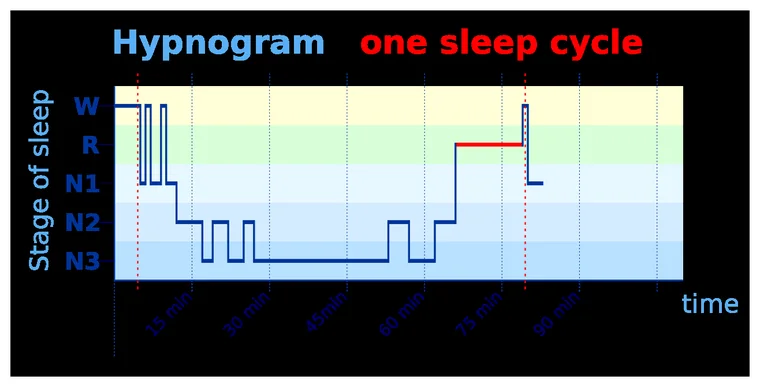
Deep sleep has three names for one thing: stage N3, slow-wave sleep, deep sleep. It is where the EEG slows into large synchronised waves, heart rate and blood pressure hit their nightly low, and waking somebody is genuinely difficult.
There is no recommended daily allowance for it, and the reason is mechanical rather than an oversight. You do not decide how much N3 you get: the brain takes it first, in the first two or three hours, and takes as much as the preceding day earned. What research can tell you is what healthy people record, as a share of the night.
The cleanest modern figures come from a study of 100 healthy sleepers aged 19 to 77, screened out of a representative population sample and recorded for a full night to current American Academy of Sleep Medicine standards. Median N3 was 20.7% of sleep in the group aged 30 or under and 14.9% in the group over 60 — which puts the commonly quoted range of roughly 13-23% in about the right place.
In the units your app uses: on a 450-minute night, 13% is 59 minutes and 23% is 104. An hour to an hour and three quarters is the ordinary adult night; three hours would make a technician re-check the scoring.
One number in that study matters more than the medians, and nobody quotes it: the spread. Reported N3 ran from 15.2% to 37.5% in the under-30 group and from 2.4% to 35.6% in the over-60 group — all screened healthy people. An adult over 60 recording 3% and one recording 35% were both inside the normal range of the same study.
Why the number falls every decade
Deep sleep is the stage that ages most visibly, and it starts early. A meta-analysis pooled 65 studies representing 3,577 non-clinical people aged 5 to 102. In children and adolescents the percentage of slow-wave sleep was significantly negatively correlated with age. In adults, total sleep time, sleep efficiency, slow-wave sleep percentage, REM percentage and REM latency all decreased significantly with age, while sleep latency, stage 1, stage 2 and time awake after falling asleep increased. Only sleep efficiency kept declining significantly after 60 — much of the deep-sleep loss has already happened by then.
That paper carries a warning for anyone comparing themselves to a chart: every one of those age effects changed size depending on how carefully the studies had screened participants for illness, alcohol and sleep apnea, and badly screened samples produced weaker or even invisible associations.
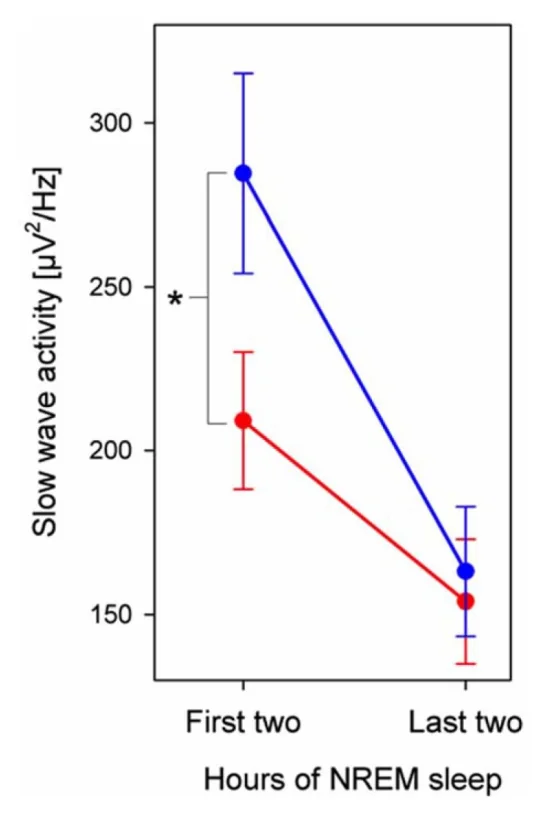
The other structural fact is where deep sleep sits: slow-wave activity peaks immediately after sleep onset and decays across the night, so the first two hours carry most of the N3 you will get.
What your tracker is actually doing with that number
Here is the part most articles on this keyword skip, and it changes the meaning of everything above. A watch cannot see your brain waves. Polysomnography scores stages from EEG, eye movement and chin muscle tone in 30-second epochs; a wearable infers them from movement and pulse timing, and an app like ours from sound and movement. Those are estimates from a model trained to approximate a scorer, not to reproduce one.
The quality of that approximation has been measured. In a laboratory study, 34 healthy young adults were recorded for three consecutive nights — one deliberately disrupted — with polysomnography plus actigraphy and seven consumer devices. For detecting sleep at all the result is good: epoch-by-epoch sensitivity was at least 0.93 for every device. But specificity, correctly calling wake, ranged from 0.18 to 0.54; stage comparisons were described as mixed; and the devices did worse on the more disrupted nights — precisely the nights people go looking at their numbers.
A 2026 study asked whether age changes this, comparing a Fitbit Sense 2, an Oura Ring, a Withings Sleep Mat and a SleepScore Max against polysomnography in 13 adults aged 19-24 and 19 aged 56-80. In the older group the devices underestimated total sleep time by 46 to 76 minutes depending on the device — the smallest gap did not reach significance — and overestimated deep sleep time by 71 minutes (Oura), 89 (SleepScore Max) and 97 (Withings Sleep Mat). The authors' summary is blunt: devices performed poorly in identifying individual sleep stages, particularly deep sleep.
That cuts both ways: the reassuring number is no more trustworthy than the frightening one.
One night is not data
Even a perfect estimate from a single night would be weak evidence, because sleep architecture reacts to the day it follows. Alcohol, a late heavy meal, a warm room, an evening training session, a cold coming on — each reshapes the night, and the effect lands in exactly the stages people screenshot. There is a feedback loop too: checking a low score each morning and then going to bed monitoring yourself for the same thing is a recognised route into worse sleep.
Use stage numbers the way a doctor uses a blood pressure diary: never one reading, always the trend across two to four weeks, always alongside how you feel in the afternoon. If daytime sleepiness is the real complaint, the Epworth Sleepiness Scale is a validated ten-second version of that question.
What to do if the number really is low
Suppose you have watched it for a month and it really is consistently low. A short list covers it.
- Add time in bed first. Deep sleep is front-loaded, so it is relatively protected on a short night — but five hours still contains less N3 than seven and a half. Sleeping longer is the only change that reliably raises the absolute minutes.
- Move alcohol away from bedtime. It alters sleep architecture at doses most people would call small, and the effect is on the stages.
- Check the room temperature. Slow-wave sleep is temperature-sensitive, and an overheated bedroom is the most common fixable cause of a shallow first half. Our page on the ideal sleeping temperature has the numbers.
- Take snoring seriously. Untreated sleep apnea fragments the night with arousals, and those hit deep sleep hardest — by far the most common medical reason for a genuinely flat N3 curve.
- Keep the wake time fixed. Consistency does more for sleep architecture than any supplement.
The full version is in how to get more deep sleep. If you doubt the stages are being measured usefully at all, tracking sleep without a wearable covers the alternatives.
See a doctor rather than adjusting your habits if a low deep-sleep reading comes with loud snoring, witnessed pauses in breathing, or waking gasping or choking — that combination points toward sleep apnea, the most common medical cause of fragmented deep sleep. Also get assessed if you sleep seven hours or more and are still exhausted during the day, if you fall asleep unintentionally while sitting still, if you have morning headaches most days, or if low mood, weight change or new pain arrived with the sleep change. A number from a watch, ring or phone app is not a diagnosis and cannot rule any of this in or out.
Where SleepTrace fits
We build a sleep tracker that runs on an iPhone microphone, so we have an obvious incentive to tell you stage numbers are meaningful. Instead: our deep-sleep figure is a model's estimate from sound and movement, on the right-hand side of the comparison above alongside every watch and ring. It is not polysomnography and we do not present it as such.
What a phone adds is the thing a wrist cannot: the audio. If your deep sleep looks thin, the useful question is why, and the answer is often audible — snoring, a pause, a partner, a road. Playing back the moment a night broke up is worth more than a more confident percentage. Start with deep sleep vs REM, or work out your own window with the sleep calculator.
Frequently asked questions
For most healthy adults, somewhere between about 60 and 110 minutes, which is roughly 13-23% of total sleep. There is no fixed minimum, because deep sleep is taken as a share of the night rather than as a quota you fill. If you sleep seven and a half hours and spend a fifth of it in stage N3, that is entirely normal; if you sleep five hours, you will get less deep sleep in absolute minutes simply because there is less night.
Usually between one and two hours, and almost never more than two in an adult. Healthy young adults in laboratory studies cluster around 20% of sleep time in stage N3; people over 60 sit closer to 15%, and some entirely healthy older adults record very little. Thinking in hours is slightly misleading, though — the share of the night is what the research reports, because a long night and a short night produce very different hour counts at the same percentage.
It drops with every decade, and that is normal rather than a warning sign. Measured with current scoring standards, median deep sleep was 20.7% of sleep in healthy people under 30 and 14.9% in those over 60. The spread within each age band is enormous — the reported range in the under-30 group ran from 15.2% all the way to 37.5% — so a number well outside the average is common in people with no sleep problem at all.
It is below the typical range for a full night, but on its own it means very little. Three things produce a low reading far more often than a real deficit does: a short night, an inaccurate estimate from a wrist or phone device, and one bad night in an otherwise ordinary week. If the figure is consistently low across several weeks and you also wake unrefreshed, feel sleepy during the day, or snore heavily, that combination is worth a doctor's time — the single number is not.
References
- Mitterling T, Högl B, Schönwald SV, Hackner H, Gabelia D, Biermayr M, Frauscher B. Sleep and Respiration in 100 Healthy Caucasian Sleepers--A Polysomnographic Study According to American Academy of Sleep Medicine Standards.. Sleep (2015). Europe PMC
- Ohayon MM, Carskadon MA, Guilleminault C, Vitiello MV. Meta-analysis of quantitative sleep parameters from childhood to old age in healthy individuals: developing normative sleep values across the human lifespan.. Sleep (2004). Europe PMC
- Chinoy ED, Cuellar JA, Huwa KE, Jameson JT, Watson CH, Bessman SC, Hirsch DA, Cooper AD, Drummond SPA, Markwald RR. Performance of seven consumer sleep-tracking devices compared with polysomnography.. Sleep (2021). Europe PMC
- Searles ME, Licata A, Cucinotta M, Kainec K, Spencer RMC. Performance evaluation of consumer sleep-tracking wearables and nearables in healthy young and older adults.. Sleep Adv (2026). Europe PMC
SleepTrace is a wellness app, not a medical device. This article is general information, not medical advice. If your symptoms are frequent, severe or worrying, please talk to a doctor.
Hear your own night. SleepTrace turns a night of audio into your sleep phases, the sounds you made, and how it all trends — no wearable, just the iPhone on your nightstand. Download on the App Store →