Slow breathing before bed — roughly six breaths a minute, and in any case ten or fewer — reliably lowers physiological arousal: heart rate drops, heart rate variability rises, and people report feeling calmer and falling asleep faster. The evidence that it produces more deep sleep is much weaker than the internet suggests. A 2026 systematic review of nine studies and 457 participants found that self-reported sleep duration and quality improved after slow breathing at bedtime, but that the studies measuring sleep objectively with actigraphy or polysomnography were inconclusive — and the objective studies mostly ran for a single night while the positive self-report studies ran for 28 to 30 days. The one polysomnographic trial that looked specifically for a deep-sleep effect found higher central delta power during N3 after 30 minutes of slow breathing, in 20 people, in an explicitly exploratory pilot whose own conclusion was that neither intervention had robust effects on sleep quality. The techniques are still worth doing: they are free, carry no risk for most people, and they act on presleep arousal, which is the actual reason most people lie awake. Just expect a faster, calmer sleep onset rather than a bigger deep-sleep bar in the morning.
Search for a breathing exercise and you will be told, within two paragraphs, that it increases deep sleep. It is the promise that sells the technique, it appears on the app store page of almost every meditation app, and it is not supported by the evidence that exists.
What the evidence does support is arguably more useful, because it addresses the thing that is actually keeping most people awake. This page separates the two.
Breathing for deep sleep: what is proven and what is not
The best current summary is a 2026 systematic review that searched Web of Science, MEDLINE and PsycINFO, followed PRISMA, and graded the evidence with GRADE. Nine studies met the inclusion criteria — slow breathing at ten breaths a minute or fewer, practised before bedtime — covering 457 participants in total.
Its findings split cleanly along the line between what people report and what instruments record. Seven studies used self-reported sleep measures, and those showed improvements in both sleep duration and sleep quality. Two used actigraphy and three used polysomnography, and the review calls those objective results inconclusive.
Before dismissing the self-reports as wishful thinking, note the design asymmetry the reviewers point out: the three objective studies mostly used a one-day intervention, while five of the self-report studies ran for 28 to 30 days. A single night of slow breathing is not a fair test of a habit, and nobody has yet run a month-long protocol with electrodes attached. The conclusion the authors actually reach is a call for better studies, not a verdict either way.
The number that matters: about six breaths a minute
Whatever the branding, the mechanism under every one of these techniques is the same, and it is a rate. Adults at rest breathe roughly twelve to sixteen times a minute. Deliberately slowing to around six — and lengthening the exhale relative to the inhale — produces a large, immediate rise in heart rate variability and a shift toward parasympathetic dominance. Six breaths a minute is close to the rate at which the breathing rhythm and the natural oscillation in blood pressure line up, which is why it comes up so often in the literature.
The systematic review's inclusion threshold was ten breaths a minute or fewer, which is a good practical floor: below that, you are doing the thing that has been studied. Above it, you are just breathing.
The techniques, and what separates them
- Paced slow breathing. Breathe in for four or five seconds, out for five or six, at a steady rhythm, for five to twenty minutes. This is the plain version used in most of the research and it has no branding attached. If you want to keep it simple, this is the one.
- 4-7-8. Inhale through the nose for four, hold for seven, exhale through the mouth for eight, four cycles. Popularised by Andrew Weil; the hold makes it noticeably harder at first and the long exhale is the working part. In a six-week randomised controlled trial, 23 patients with tinnitus practising 4-7-8 against 25 controls who received only an information session showed significant reductions in insomnia severity, trait anxiety and perceived stress, while the control group's scores did not change from baseline.
- Box breathing. Four seconds in, hold four, out four, hold four. Its evidence base is about acute stress rather than sleep: in a randomised trial, 66 people did normal breathing, prolonged exhalation or box breathing before a virtual Trier Social Stress Test, and both breathing conditions blunted the post-stressor rise in heart rate, state anxiety and salivary alpha-amylase compared with normal breathing. Heart rate variability, cortisol and cognitive performance showed no difference between conditions.
- Diaphragmatic breathing. Not a count at all, but a technique — breathing into the belly rather than the upper chest, usually lying on your back with a hand on the abdomen. It is the foundation the others are built on, and the Wikipedia description of diaphragmatic breathing covers the mechanics. Most people who find 4-7-8 uncomfortable are breathing with the chest.
No study has convincingly shown one of these beating another for sleep. Choose on comfort, because compliance over four weeks is the only variable that has been associated with a result.
What happened when researchers attached electrodes
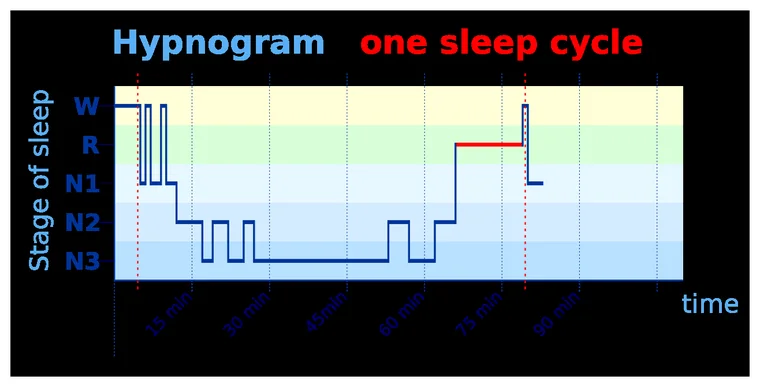
One study looked directly for the effect this article's keyword promises. Twenty young adults, half women, slept two consecutive nights under polysomnography — 40 nights in total — in a randomised crossover design, with one night serving as its own control. The intervention was either 30 minutes of slow breathing or 30 minutes of listening to music, specifically Max Richter's Sleep.
Both interventions raised heart rate variability immediately, confirming that the physiological handle is real. Music listening decreased N2 sleep, increased frontal beta1 power and produced a trend toward increased N3. The slow-breathing condition produced higher central delta power during N3 — delta being the slow-wave activity that defines deep sleep, so this is the single closest published result to "breathing deepened my deep sleep".
And then the authors' own conclusion: while some indices pointed to improved sleep quality in both groups, neither condition had robust effects on sleep quality, and they described the findings as explorative and in need of replication in different populations. Twenty people, one night per condition, young and healthy. That is a signal worth following up, not a claim to build a product page on.
How to actually do it tonight
Treat it as a wind-down routine rather than a lever.
- Pick one technique and keep it for a month. The positive self-report studies ran 28 to 30 days. Switching nightly guarantees you learn nothing.
- Do it before lights out, not as a sleep-forcing tool. Ten to thirty minutes of paced breathing while already in bed, lights low, phone elsewhere. Using it as a stopwatch to fall asleep turns it into performance pressure, which is the opposite of the intended effect.
- Make the exhale longer than the inhale. This is the one parameter shared by every protocol that produced a result.
- Breathe through the nose on the way in, and into the belly. If your shoulders rise, you are chest-breathing and the rate will feel unsustainable.
- Judge it on how falling asleep feels, not on your deep-sleep bar. The bar is an estimate, and this is not the intervention that moves it.
If lying awake wound-up is the actual problem, tired but can't sleep covers the broader version, and meditation and relaxation to fall asleep covers the neighbouring techniques. For the things that do have evidence behind them for deep sleep specifically, see how to get more deep sleep.
Breathing exercises are not a treatment for a breathing problem during sleep. If you snore heavily, have been told you stop breathing, wake gasping or choking, or wake with a headache most mornings, that pattern points toward sleep apnea, and no bedtime technique treats it — it needs a proper assessment and, usually, a device. Stop and speak to a doctor if a breath-hold makes you dizzy, light-headed or faint, and skip breath retention entirely if you are pregnant, have uncontrolled high blood pressure, a heart or lung condition, panic disorder, or a history of hyperventilation attacks. Paced breathing without holds is gentler and has the same evidence behind it. Persistent insomnia lasting more than three months has a first-line treatment — cognitive behavioural therapy for insomnia — that works better than any breathing technique and is worth asking for by name.
Where SleepTrace fits
We are not going to tell you that our app proves your breathing exercise worked, because our deep-sleep figure is an estimate from sound and movement and is not precise enough to settle a question that a polysomnography pilot could not settle.
What an iPhone by the bed can tell you is the part you can actually act on: how long it took you to settle, whether your nights are getting quieter, and whether the snoring or the 03:40 disturbance that keeps breaking the night is still there. If the answer is that something audible keeps waking you, that is a more productive target than a longer exhale. For the underlying numbers, start with how much deep sleep do you need.
Frequently asked questions
The one you will actually do for a month, practised at a slow rate. Across the research, the shared active ingredient is a breathing rate of about six breaths a minute or slower, with the exhale at least as long as the inhale — whether that is packaged as 4-7-8, as box breathing, or as plain paced breathing does not appear to matter much. The studies that produced positive results on sleep ran for 28 to 30 days, so treat it as a nightly habit rather than a rescue technique.
There is no solid evidence that it does. A 2026 systematic review found self-reported sleep improvements but called the objective measurements inconclusive. The single most relevant experiment, a polysomnographic crossover pilot in 20 young adults, did find higher central delta power during N3 sleep after slow breathing, which is the closest thing to a deep-sleep signal anyone has published — but the same paper reported no robust effect on sleep quality and asked for replication. Anyone promising you more deep sleep from breathing is going beyond the data.
Inhale through the nose for a count of four, hold for seven, exhale through the mouth for eight, and repeat four times. That works out to roughly three breaths a minute with a very long exhale, which is well inside the slow range that shifts the body toward parasympathetic dominance. In a six-week randomised controlled trial in patients with tinnitus, the group practising 4-7-8 showed significant reductions in insomnia severity, anxiety and perceived stress while the control group did not change.
It is good at calming you down, which is often the same thing in practice. In a randomised trial of 66 people facing a laboratory stress test, both box breathing and prolonged exhalation blunted the rise in heart rate, state anxiety and salivary alpha-amylase compared with normal breathing — although heart rate variability and cortisol did not differ. That is an acute stress-buffering effect rather than a sleep-architecture effect, so use box breathing for the wound-up feeling at bedtime, not as a deep-sleep intervention.
References
- Eide EM, Hernes HM, Grønli J. Slow breathing techniques before bedtime and the effects on sleep: A systematic review.. Sleep Med Rev (2026). Europe PMC
- Kuula L, Halonen R, Kajanto K, Lipsanen J, Makkonen T, Peltonen M, Pesonen AK. The Effects of Presleep Slow Breathing and Music Listening on Polysomnographic Sleep Measures - a pilot trial.. Sci Rep (2020). Europe PMC
- McAllister MJ, Martaindale MH, Sutton N, Andersen JP. Box breathing and prolonged exhalation reduces markers of physiological stress reactivity in response to a virtual trier social stress test.. Compr Psychoneuroendocrinol (2026). Europe PMC
- Kirazli G, Baran S, Uysal GS, Ozdogan A, Durankaya SM, Ogut MF. The Effect of 4-7-8 Breathing Exercise Technique on Tinnitus Handicap, Psychological Factors, and Sleep Quality in Tinnitus Patients: A Randomized Controlled Study.. Brain Behav (2026). Europe PMC
SleepTrace is a wellness app, not a medical device. This article is general information, not medical advice. If your symptoms are frequent, severe or worrying, please talk to a doctor.
Hear your own night. SleepTrace turns a night of audio into your sleep phases, the sounds you made, and how it all trends — no wearable, just the iPhone on your nightstand. Download on the App Store →