Seasonal affective disorder is recurrent depression tied to the changing light of autumn and winter — and at its core it's a circadian (body-clock) and light problem, not just a mood problem. The leading explanation is that shorter days shift your internal clock and serotonin/melatonin rhythms, leaving you sluggish, low, and sleeping oddly — often oversleeping but waking unrefreshed. The most evidence-backed treatment is bright light therapy, typically 10,000 lux for 20–30 minutes each morning, which reliably improves SAD symptoms. Sleep timing, morning light exposure, and consistent wake times are the daily levers you control.
Every autumn it comes back: the heaviness, the urge to hibernate, sleeping ten hours and waking up still tired, craving carbs, dreading the daylight that barely shows up anyway. For people who only feel this way when the seasons turn, it has a name: seasonal affective disorder — SAD. And it's not the 'winter blues' that people politely shrug off. It's a real, recurrent condition with a known biology and a treatment that actually works.
Seasonal affective disorder therapies: what actually helps
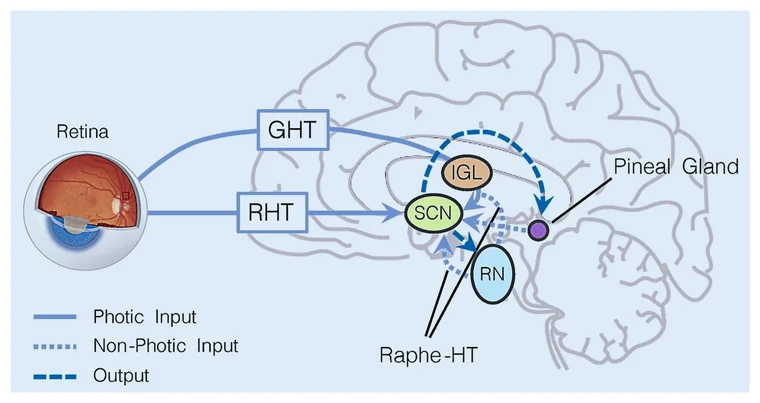
The central clue in SAD is the timing. Symptoms start as the days shorten, peak in winter, and lift in spring. The condition is documented under its clinical name in the Wikipedia overview of seasonal affective disorder. That seasonality points to what's driving it: light. Your circadian clock — the internal timing system that regulates sleep, hormones, and mood — uses morning light as its strongest 'reset' signal. In winter, that signal is late, weak, or absent, so the clock drifts. Melatonin (the sleep hormone) is released earlier and hangs around longer, and mood-relevant brain chemistry follows. The result: a body that feels like it's stuck in a dim twilight — sluggish, low, and sleeping at the wrong time.
The sleep side of SAD
SAD's sleep signature is usually different from classic depression. Instead of insomnia, most people with SAD report hypersomnia — sleeping far more than usual but waking unrefreshed, and finding it brutally hard to get up in the dark. That oversleeping isn't laziness; it's the circadian clock producing sleep pressure at the wrong times. In the winter months, your body may be signaling 'it's night' for half the waking day. That mismatch — sleepy at the wrong time, unrefreshed at the right time — is the daily lived experience of SAD.
What actually helps: the light therapy evidence
The best-studied treatment is bright light therapy — sitting near a 10,000 lux light box (much brighter than indoor lighting) for roughly 20–30 minutes each morning. Reviews of the evidence consistently find it improves SAD symptoms, and it's widely considered a first-line treatment. It works by doing what winter withholds: delivering a strong 'morning has arrived' signal that re-anchors your circadian clock.
There are honest caveats worth naming. Light therapy helps most people but not everyone, and it works best as part of a bigger picture — consistent sleep timing, morning light exposure (even a cloudy morning walk beats none), and treatment for the depression itself where it's needed. A 2026 review of bright light therapy across psychiatric disorders describes its mechanisms and clinical procedures in detail, and underscores that the procedure matters: intensity, timing, and duration all count.
The daily levers you control
- Morning light, on purpose. Get outside in the morning — the earlier the better — and for SAD specifically, consider a proper 10,000 lux light box first thing.
- Hold a consistent wake time. In winter the urge is to sleep in; the circadian system rewards a fixed wake time more than a fixed bedtime.
- Don't hibernate. Evening light matters too, but the morning anchor is the one that pulls the clock into line. And movement — even a short walk — breaks the sluggish loop.
- Watch the sleep signs. If you're consistently oversleeping yet unrefreshed every winter, that's a pattern worth taking to a doctor, not just 'the season'.
SAD is the body saying: the light is gone and my clock doesn't know what time it is. Light therapy is giving it the answer.
The dawn-simulation option
If a bright light box feels like a big apparatus, the research also supports a gentler variant that fits the mechanics better for some people: dawn simulation. Instead of a sitting session of bright light in the morning, a dawn-simulating lamp fades in like a sunrise across your final hours of sleep, synchronising your internal clock with the day. Trials of dawn simulation report meaningful improvements in seasonal mood and energy, and it has the advantage of being passive — you do not have to remember a session, the light works while you sleep.
It is not the level of the therapy-grade light box, and it cannot replace a professional assessment of a genuine SAD diagnosis. But for the typical winter pattern — sluggish mornings, low daytime mood, craving sleep — a dawn lamp on the nightstand is a low-effort, low-risk daily lever that most seasonal people find worth having. Pair it with the daylight walk and the fixed schedule, and the seasonal slump has several cheap, real countermeasures before anything prescription-grade is needed.
Where SleepTrace fits
Because SAD's most reliable signal is in your sleep — the oversleeping, the unrefreshing quality, the timing drift across the season — it's a condition where measuring the night gives you real information. SleepTrace records your sleep with just your iPhone and shows your sleep stages and timing, so you can see whether your winter nights are actually changing, and whether light therapy and a fixed wake time are pulling them back. Read jet lag and your circadian rhythm to understand the clock, or sleep deprivation symptoms.
Frequently asked questions
SAD is a type of depression that recurs with the seasons — symptoms begin in autumn, peak in winter, and lift in spring. It's tied to the changing light and how it affects your circadian clock, melatonin, and mood-related brain chemistry.
Yes, it's the best-evidenced treatment. A 10,000 lux light box used for 20–30 minutes each morning reliably improves SAD symptoms by delivering the strong 'morning' signal winter withholds. Intensity, timing, and consistency matter — it's a procedure, not a lamp to sit near casually.
That's the classic SAD sleep pattern: hypersomnia. Short days make your circadian clock produce sleep pressure at the wrong times, so you sleep longer but wake unrefreshed. It's a clock problem, not laziness — and it's why morning light and a consistent wake time help.
It's a more serious, diagnosable version. The 'winter blues' is a mild, common mood dip. SAD is recurrent depression tied to the season that meaningfully disrupts sleep, energy, and functioning — and it responds to specific treatment, so it's worth taking seriously rather than shrugging off.
References
- Campbell PD, Miller AM, Woesner ME. Bright light therapy: seasonal affective disorder and beyond. Einstein J Biol Med (2017). Europe PMC
- Pardossi S, Bossini L, Milani V, et al. Bright light therapy in psychiatric disorders: mechanisms, clinical procedures and evidence. Life (Basel) (2026). Europe PMC
SleepTrace is a wellness app, not a medical device. This article is general information, not medical advice. If your symptoms are frequent, severe or worrying, please talk to a doctor.
Hear your own night. SleepTrace turns a night of audio into your sleep phases, the sounds you made, and how it all trends — no wearable, just the iPhone on your nightstand. Download on the App Store →