Blue light glasses work in theory and help somewhat in practice — but the honest picture is that the evidence is mixed and the effect is modest. Blue light in the evening does suppress melatonin and delays sleep onset; that part is well established. Filtering that light with amber glasses has shown small-to-medium benefits in some meta-analyses, mainly for sleep efficiency and self-reported sleep quality, and the evidence is strongest for people with insomnia, delayed sleep phase, or high evening screen exposure — not necessarily for healthy adults. The bigger point: glasses filter one input, but the behaviors around them matter more. Dimming the room, using warm 'night mode' at low brightness, limiting screens before bed, and having a consistent wind-down will do more for your sleep than the glasses alone. And cheap amber glasses aren't worse than expensive 'blue-light' brands for the sleep effect — the tint is the mechanism.
Blue light glasses are one of those products everyone has an opinion on. Fans swear they sleep better. Skeptics call them a $30 placebo. The truth, as usual, sits in the middle — and the science explains exactly why.
Do blue light glasses work: the mechanism is real
Blue light (roughly 460–480 nm) is the primary stimulus for the cells in your eyes that tell your brain's master clock what time it is. The optical properties that make it so relevant at night are covered in the Wikipedia article on blue light. In the evening, bright blue light suppresses melatonin — the hormone that signals 'night is coming' — and shifts your circadian phase later. That's not marketing; it's well-established physiology. Screens are blue-light-rich, which is why evening scrolling and 'tired but wired' go together.
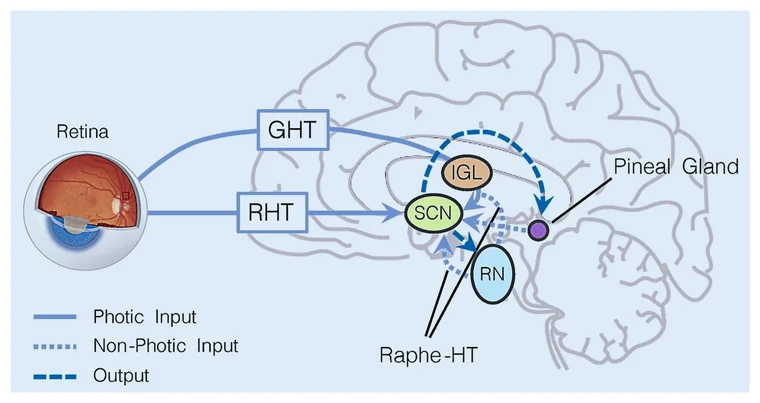
So in principle, filtering blue light in the evening should help. The question is whether the glasses deliver.
What the research actually shows
The studies are mixed, and the honest summary has two parts. On one hand, a systematic review and meta-analysis of evening blue-light-blocking glasses found small-to-medium benefits — better sleep efficiency and longer total sleep time in some analyses, and notably larger improvements in self-reported sleep quality. Another systematic review concluded there's substantial evidence the glasses reduce sleep-onset latency in people with sleep problems, jet lag, or shift work.
On the other hand, the effect is not universal. A randomized crossover trial in healthy adults found blue-light-blocking glasses improved subjective sleep (faster perceived sleep onset, fewer reported awakenings) but did not improve objective sleep measures. And a 2025 meta-analysis of the most rigorous randomized crossover trials found no statistically significant improvement in actigraphy-measured sleep. The pattern: the glasses help some people — particularly those whose sleep is already struggling — while healthy good sleepers see little measurable change.
The honest verdict: should you buy them?
If you're a heavy evening screen user, especially with late-night scrolling, amber glasses are a reasonable, low-cost, low-risk experiment — the evidence for helping is real, particularly for sleep onset. Three honest caveats:
- Don't expect a cure. The studies show modest help, not transformation. If your sleep is fundamentally disorganized, the glasses aren't the fix.
- The tint is the mechanism, not the brand. For the sleep effect, cheap amber lenses block the relevant wavelengths about as well as expensive 'blue-light' brands. Spend a little, not a lot.
- Glasses aren't a substitute for behavior. Filtering blue light while still scrolling in a bright room at midnight is fighting one battle and ignoring the war.
What matters more than the glasses
The research on evening light is clear that the total light load matters: dimming the room, enabling warm 'night mode' at reduced brightness, and putting the screens down are each free moves that do at least as much as the glasses. And the deeper truth is that what you're protecting — your evening wind-down and your sleep timing — is affected by far more than light. Screen content, notifications, stress, and caffeine all shape how well you fall asleep.
Amber glasses filter one input. Your wind-down — dim lights, warm tones, screens down, a consistent bedtime — filters the whole night.
Where to spend your money instead
If the research does not justify a dedicated pair of glasses, what does? The cheap and honest answer: built-in night modes. Apple's Night Shift, Android's Night Light, and a free blue-light app do most of what the glasses claim, accept the same trade-off (a glowing screen is still a glowing screen), and cost nothing. The glasses only make sense if they replace behaviour you cannot change another way, and even then a plain pair without a "blue light" label does the job if it is tinted amber.
The bigger lever is the one that never sells a product: the exposure is circadian even in perfect "white" light, because what your brain cares about is how bright and how long, not the wavelength marketing. Dimming screens after dark, keeping the phone out of the last hour, and saving the bright stuff for the morning beats any shade of lens. A cheap way to think of it: buy the night mode before you buy the glasses.
Where SleepTrace fits
If you're wondering whether evening light — or anything else — is hurting your sleep, the first step is measuring the night, not guessing. SleepTrace records your sleep with just your iPhone and shows your sleep stages, sleep-onset latency, and how your nights actually look. Try a week with the glasses and a proper wind-down, and compare: did your sleep onset improve? That's the experiment the research can't run for you. Start with how to get more deep sleep, or read how sleep phases work.
Frequently asked questions
They help somewhat, and the effect is modest and mixed in the research. Evening blue light genuinely suppresses melatonin and delays sleep onset, so filtering it can help — especially for people with insomnia, delayed sleep phase, or heavy evening screen use. In healthy good sleepers, the measurable objective benefit is small; subjective sleep improvement is more consistent.
Not for the sleep effect. The tint is the mechanism — cheap amber lenses block the relevant wavelengths about as well as expensive 'blue-light' brands. For sleep purposes, spend a little, not a lot.
In the 2–3 hours before bedtime, which is when evening light most affects melatonin. They help most if you can't avoid screens late in the evening. But they work best alongside the bigger moves: dim room lighting, warm night-mode screens, and a screen-free wind-down.
Not for sleep. Blue light during the day is actually useful — it helps anchor your circadian clock and keeps you alert. The eye strain you might feel from screens is mostly from focus and glare, not blue light; for that, taking breaks and adjusting screen distance help more than tinted glasses.
References
- Shechter A, Quispe KA, Mizhquiri Barbecho JS, et al. Interventions to reduce short-wavelength ("blue") light exposure at night and their effects on sleep: A systematic review and meta-analysis. Sleep Adv (2020). Europe PMC
- Hester L, Dang D, Barker CJ, et al. Evening wear of blue-blocking glasses for sleep and mood disorders: a systematic review. Chronobiol Int (2021). Europe PMC
SleepTrace is a wellness app, not a medical device. This article is general information, not medical advice. If your symptoms are frequent, severe or worrying, please talk to a doctor.
Hear your own night. SleepTrace turns a night of audio into your sleep phases, the sounds you made, and how it all trends — no wearable, just the iPhone on your nightstand. Download on the App Store →