A false awakening is a dream in which you dream that you have woken up — usually in your own bed, in your own room, doing an ordinary thing like turning off the alarm or making coffee. Then you wake up for real and realize none of it happened. It comes out of REM sleep, and the reason it is so convincing is that the dream reuses the most rehearsed scene you own: your bedroom and your morning. A false awakening loop is the same thing repeating, two, three or five times in a row, each fake waking feeling as real as the last. The rare laboratory recordings that exist are tiny — one study captured just two episodes — but they point the same way: the EEG during a false awakening is dominated by theta rhythm, closer to REM sleep than to wakefulness, which means the brain is still in a dreaming state rather than half awake. False awakenings sit in the same family as sleep paralysis and lucid dreaming, and in surveys people who report one tend to report the others. They are not a disorder, they are not dangerous, and no treatment is needed — though frequent ones tend to appear alongside broken or stressed sleep, which is the thing worth addressing.
The alarm goes. You reach over and stop it, swing your legs out, stand up, notice the light through the curtains is wrong somehow, walk to the kitchen — and wake up. In bed. Alarm still going. You do it again. This time you check your phone to make sure you are awake, and the numbers on the screen will not hold still. You wake up again.
That is a false awakening, and if it has happened to you in a run of three or four, you already know that no description quite conveys how disorienting it is. What follows is what is actually known about it — which is less than you would expect, and more interesting than the usual explanations suggest. The general definition is also summarized on Wikipedia's false awakening page.
What a false awakening actually is
It is a dream about waking up. That is the entire mechanism, and the interesting question is not what happens but why it is so persuasive when ordinary dreams, for all their vividness, are usually recognizable as strange afterwards.
The answer is set design. Dreams are built from what you know, and there is no scene you know better than your own bedroom on an ordinary morning. You have rehearsed it thousands of times: the exact angle of light, the sound of the alarm, the order you do things in, the specific grain of the ceiling. When a dream assembles that scene, it is working with unusually high-resolution material, and it does not need to invent anything implausible. Nothing flags as wrong, because nothing is wrong. You are simply not there.
This also explains the classic tell. Text, clocks and light switches are the details that misbehave in false awakenings — digits that rearrange when you look twice, a switch that does nothing. Those are the parts of the scene that require live generation rather than recall, and they are the parts that fail.
Why it loops
A false awakening loop is the same event two, three or five times over. Each repetition is equally convincing, and the frustration of the later ones is often part of the dream itself — the sense of "not again" while still inside it.
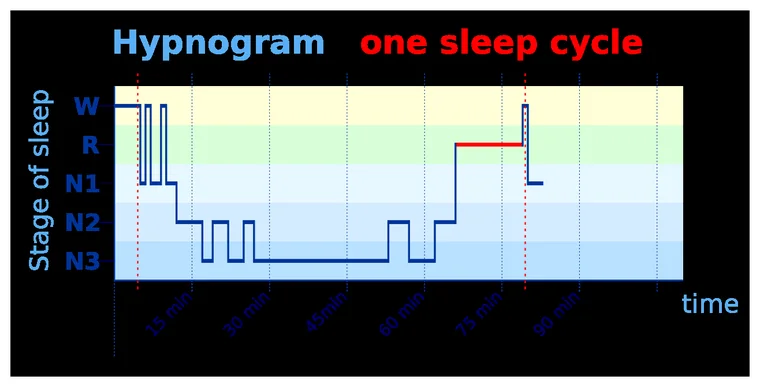
Nothing exotic is required to explain this. REM periods lengthen through the night and are longest in the last couple of hours before you get up, so the back end of the night is where dreams are most abundant and sleep is lightest. Dropping out of one REM dream and straight back into another is ordinary. When the set is already built and the situation is unresolved — the alarm still going, the day still not started — the brain reuses it. There is no reality check available from inside, because the thing you would check with is also being dreamed.
What the EEG shows — and how little of it there is
False awakenings are almost impossible to study, for an obvious reason: you cannot schedule one, and the person having it does not know they are having it. Sleep laboratories have captured very few.
One French group managed two. In a study of five participants, researchers captured five episodes of sleep paralysis and two episodes of false awakening, and compared the EEG during them against normal REM sleep, wakefulness and lucid REM sleep in people with narcolepsy. During sleep paralysis, 70.8% of the three-second mini-epochs contained theta rhythm, compared with 89.7% in REM sleep and 21.2% in wakefulness. The spectral profile during false awakening followed the same pattern as during sleep paralysis: intermediate between wake and REM in the alpha, theta and delta bands. The authors' conclusion was that the brain in these states is not in an awake state but in a dreaming one.
Two episodes is two episodes. This is a finding to hold lightly rather than quote as settled. But it lines up with what the experience itself reports — total conviction of being awake, with none of the mental sharpness that would come with actually being awake — and it supports the way this family of states is now classified. A 2023 review groups daydreaming, lucid dreaming and false awakenings together as physiological sleep-related dissociative states, distinct from the pathological group that contains sleep paralysis, sleepwalking and REM sleep behavior disorder. False awakening is on the normal side of that line.
The company it keeps: sleep paralysis and lucid dreams
False awakenings, sleep paralysis and lucid dreaming turn up in the same people. In an online survey of 1,928 participants aged 18 to 82, sleep paralysis and lucid dreaming frequency were positively related, and the association was strongest between lucid dreaming and sleep paralysis episodes involving vestibular-motor hallucinations — the floating and out-of-body sensations. The two were predicted by different things, though: sleep paralysis by sleep quality, anxiety and life stress; lucid dreaming by a positive, constructive daydreaming style and vivid sensory imagery.
That split is useful. It suggests these states share a mechanism — the boundary between REM and wake being permeable — while what pushes you across it differs. And it is a reminder that "I get false awakenings and sleep paralysis" describes a type of sleeper, not a diagnosis.
For scale: a systematic review of 35 studies covering 36,533 people found that 7.6% of the general population, 28.3% of students and 31.9% of psychiatric patients had experienced at least one episode of sleep paralysis in their lifetime. These states are common. If you have had them, you are in ordinary company — and if you want the specifics of that one, read about the sleep paralysis demon and whether sleep paralysis can kill you.
How to get out of a loop
There is no technique with evidence behind it, and anyone claiming otherwise is improvising. But two things follow from the mechanism, and people who get these often report both working.
- Check something that has to be generated, not remembered. Text and digital clocks are unstable in dreams. Read a sentence, look away, read it again. If it changed, you are still asleep — and knowing that often tips the dream into a lucid one, which ends the loop because you stop trying to get up.
- Stop trying to get up. The loop is fueled by the unresolved task of starting the day. Deciding, inside the dream, to simply lie there usually ends the cycle faster than fighting through another fake morning.
The more durable fix is upstream. False awakenings become more frequent in fragmented, stressed and irregular sleep — the same conditions that make REM cram into the early morning. A steady wake time does more than any in-dream trick. And if the last two hours of your night are consistently broken, that is worth understanding on its own terms; see sleep fragmentation.
Talk to a doctor if false awakenings come with sudden daytime sleep attacks, knees buckling or a jaw going slack when you laugh, or frequent sleep paralysis — that cluster can point to narcolepsy, which is diagnosable and treatable, and is often missed for years. Also raise it if the episodes are frequent and leave you dreading sleep, if you cannot reliably tell afterwards what happened and what did not, or if they started after a trauma or alongside low mood or heavy alcohol use. A false awakening on its own is harmless; a false awakening plus a collapsing night is a reason to get looked at.
Where SleepTrace fits
You cannot record a false awakening, because nothing physical happens — that is the whole point of it. What you can record is the night around it. SleepTrace uses your iPhone to capture the sounds of the night against your sleep stages, so if the mornings you get stuck in loops are also the mornings your sleep was breaking apart from 4 a.m. onward, you can see the pattern instead of guessing at it. That does not explain the dream. It does tell you whether the nights that produce them have something in common. More on what the recording does and does not show: how to record yourself sleeping.
Frequently asked questions
A false awakening is dreaming that you have woken up. The scene is typically your own bedroom and an ordinary morning action — sitting up, checking the phone, going to the bathroom — performed with full conviction that you are awake. Only the real awakening afterwards reveals it. It arises from REM sleep, and it is considered a normal, physiological experience rather than a disorder.
Because nothing in the experience tells the brain to stop. A false awakening is a REM dream using the bedroom as its set; when it ends, you can slip straight back into REM and the same set gets used again. Each repetition feels equally real because in each one the dreaming state is intact. Loops of three to five are commonly reported and are not a sign that anything is wrong — they tend to cluster in the last hours of sleep, when REM periods are longest, and in broken or unusually stressed nights.
No. There is no physical risk, nothing is happening to your body, and nothing in the research literature treats it as a condition to be cured. It is classified alongside daydreaming and lucid dreaming as a physiological sleep-related dissociative state, rather than with sleep paralysis or REM sleep behavior disorder. The distress it causes is real, but it comes from the disorientation rather than from any harm.
In a false awakening you believe you are awake and you can move freely — in the dream. In sleep paralysis you actually are partly awake, aware of your real room, and unable to move, because the REM muscle paralysis has persisted into waking. They are related states and people who report one report the other more often, but the experience is opposite: one is convincing normality, the other is being trapped in your own body.
References
- Mainieri G, Maranci JB, Champetier P, Leu-Semenescu S, Gales A, Dodet P, Arnulf I. Are sleep paralysis and false awakenings different from REM sleep and from lucid REM sleep? A spectral EEG analysis.. J Clin Sleep Med (2021). Europe PMC
- Sodré ME, Wießner I, Irfan M, Schenck CH, Mota-Rolim SA. Awake or Sleeping? Maybe Both… A Review of Sleep-Related Dissociative States.. J Clin Med (2023). Europe PMC
- Denis D, Poerio GL. Terror and bliss? Commonalities and distinctions between sleep paralysis, lucid dreaming, and their associations with waking life experiences.. J Sleep Res (2017). Europe PMC
- Sharpless BA, Barber JP. Lifetime prevalence rates of sleep paralysis: a systematic review.. Sleep Med Rev (2011). Europe PMC
SleepTrace is a wellness app, not a medical device. This article is general information, not medical advice. If your symptoms are frequent, severe or worrying, please talk to a doctor.
Hear your own night. SleepTrace turns a night of audio into your sleep phases, the sounds you made, and how it all trends — no wearable, just the iPhone on your nightstand. Download on the App Store →