Night terrors in adults are abrupt arousals out of deep non-REM sleep: a scream or a burst of fear, a sleeper who cannot be reached, and little or no memory afterwards. In a UK telephone survey of 4,972 people, 2.2% reported them, and the rate fell with age. Research describes three layers behind an episode: a family predisposition, priming factors such as short sleep, alcohol, stress or fever, and a trigger such as a breathing problem, leg movements or noise. They differ from nightmares (REM sleep, remembered in detail) and from sleep paralysis (awake and unable to move). A first episode in adulthood, an injury, or loud snoring alongside them is a reason to see a sleep doctor, and a timestamped recording of the night makes that visit more useful.
The scream comes first. It is not a shout and it is not a word, and the person who made it is sitting upright with open eyes and cannot be reached. Two minutes later they lie back down. In the morning they remember nothing, or one frozen picture. For the partner it is a night that stays in the memory. For the sleeper it is hearsay, plus a faint leftover of fear that has no source.
Most pages on this topic are written for the parents of toddlers. This one is about the adult version, which is less common, less discussed, and tied to questions the toddler version never raises: stress, alcohol, breathing at night, and whether it could be something else entirely.
Night terrors adults have: what happens, and why it is not a nightmare
A night terror, which sleep medicine also calls a sleep terror, is an abrupt arousal out of deep non-REM sleep. A nightmare is almost the opposite on every point. It is a long, story-like dream that wakes you out of REM sleep, and you remember it. A night terror comes out of the deep, slow-wave part of the night, starts with the scream, and leaves a thin memory or none.
How common is it? In a representative telephone survey of 4,972 people in the United Kingdom, 2.2% reported night terrors. Sleepwalking was 2.0%, confusional arousals 4.2%, and all three became less frequent with age. The authors point out that the numbers are self-reported and probably too low, which is unsurprising for events the sleeper does not remember. A 2026 survey of 1,002 Norwegian adults put nightmares at 47.2% over a lifetime and found parasomnias more common in younger people. Night terrors are the rarer sibling of the bad dream, not the usual bad night.
Night terrors adults symptoms, as the person next to you sees them
What the research documents is short. One case series describes an abrupt terror with a frightening scream and no clear orientation while it lasts. Clinic descriptions usually add wide eyes, fast breathing, sweating, no response to comforting, and a return to sleep within minutes. Those additions are common clinical knowledge rather than findings of the studies cited here, so treat them as a rough sketch.
The textbook picture is no or poor mental recollection, which is easily read as dreaming nothing at all. That is too strong. A French team interviewed 38 of 43 adults referred for severe sleepwalking or sleep terrors (average age 26) and 71% could report at least one dreamlike scene attached to an episode. Almost all of them (95%) were a single visual scene, and they were rarely pleasant: apprehension in 84%, misfortune in 54%, and in 24% an aggression in which the dreamer was always the victim. The authors concluded that complex mental activity can take place during slow-wave sleep. So the scream is probably a reaction to something the sleeping brain is showing for a second or two. The sleeper just never gets the whole film.
What causes night terrors adults to start: three layers, not one
Nobody who asks what causes night terrors adults suffer from gets a single answer. A sleep-medicine review lays out three layers, and an episode needs all of them. Predisposition is genetic and runs in families. Priming factors make deep sleep heavier or arousal harder: sleep deprivation, alcohol, some medications, a stressful stretch, fever. Then comes the trigger, the last layer, something that nudges a predisposed and primed sleeper out of deep sleep. The triggers found in sleep-laboratory research were sleep-disordered breathing, periodic leg movements, noise and touch.
So the cause of night terrors adults live with is rarely one thing. It looks more like a short fuse in a sleeper whose deep sleep ran heavy this week, plus a small bump at 01:20.
In the UK survey, night terrors were associated with a subjective sense of choking or blocked breathing at night (odds ratio 5.1), obstructive sleep apnea syndrome (4.1), alcohol at bedtime (3.9), nightmares at least once a month (4.0) and hypnagogic hallucinations (2.2). The authors concluded that arousal parasomnias, night terrors in particular, are often an expression of a mental disorder. The Norwegian survey agrees in direction: most of the parasomnias it asked about were associated with insomnia, anxiety and depression.
Two cautions belong next to those numbers. A phone survey shows association, not cause, and nobody can say from it which way the arrow points. And a registry of 4,372 Norwegian patients referred for suspected sleep apnea found no increase in parasomnias in people with apnea compared with people without it. The one exception was sleepwalking, where severe apnea carried twice the odds of mild apnea (odds ratio 2.0). Breathing is a plausible trigger. It is not a proven one for everybody.
When in the night it happens
Because the arousal comes out of slow-wave sleep, the part of the night to look at is the first half. Deep sleep is front-loaded: the brain takes most of what it will take in the first two or three hours and then very little. The scored night below shows it on one real example.
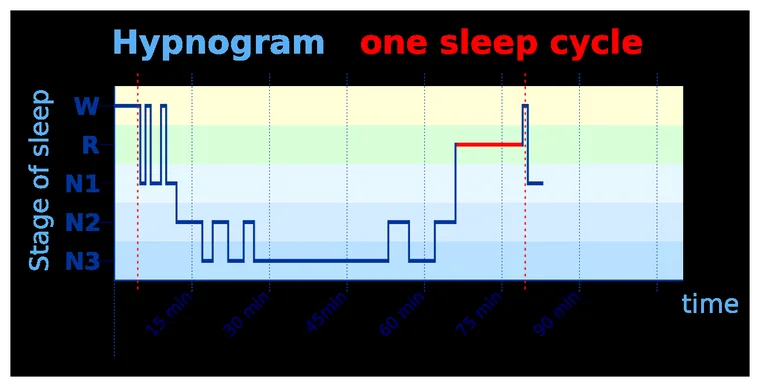
That timing is a hint, not a rule. A 2022 case series described three young women whose sleep-terror-like screaming or crying came exclusively out of REM sleep transitions, which led the authors to propose that sleep terrors may also arise from REM sleep. For most people, though, an episode in the first third of the night points toward the deep-sleep kind, and one near morning points elsewhere.
Night terror vs sleep paralysis vs nightmare
These three get confused all the time, and the confusion makes people frightened of the wrong thing. Night terror vs sleep paralysis is the pair that causes most of the worry. The difference that matters is who is awake. In a night terror the sleeper is not aware of it and the partner is the witness. In sleep paralysis the sleeper is awake and aware and cannot move, and nobody else sees anything. Telling sleep paralysis vs night terror apart afterwards is therefore simple: if you remember all of it, it was not the terror.
If the sleeper acts out a vivid dream late in the night, punching or kicking in time with a story they can describe afterwards, that is a third thing again, covered in REM sleep behavior disorder. The figure that people see during sleep paralysis has its own page: sleep paralysis demon. And if the episode ends with the person walking around, why people sleepwalk is the same family of events.
What you can and cannot change
How to prevent night terrors adults: shrink the triggers, not the dream
Nothing in the research is a switch. What it offers follows the three layers. You cannot change the predisposition. You can change some priming and some triggers.
- Protect sleep length. Sleep deprivation is a named priming factor, and in laboratory studies of sleepwalkers it generally raised complex behaviours during deep sleep, although one prominent study found the opposite.
- Look at alcohol with some suspicion. The survey link is real, the mechanism is uncertain, and one review is sceptical. Noticing whether episodes cluster on drinking nights costs nothing.
- Get the triggers looked at rather than guessed. The same review notes that treating triggers such as sleep-disordered breathing or periodic leg movements may end episodes without any medication. That is a job for a sleep clinic, not for a guess from the sofa.
- Mind the room. Noise and touch were found as triggers. A partner who shakes or shouts at a sleeper mid-episode may be adding one.
No medicine or supplement is recommended here. Whether any treatment is right is a decision for a doctor who knows the full history, including what you take at night.
What a recording of the night can add
A 2023 review of how these events are diagnosed makes a pointed observation: the usual diagnostic questions about amnesia and about having no conscious experience during the episode are poor at catching them. The review encourages video-polysomnography and home video recordings in the work-up, and suggests three levels of diagnostic certainty. In plain terms, the field wants evidence from the night itself, because the sleeper's memory is the weakest witness.
An audio recording is not a video, but it is the part of the night you can most easily capture. A phone on the nightstand can give you three things memory cannot. First, when the scream happened relative to the time you fell asleep. Second, whether it repeats at a similar time on several nights, which is what a short-fuse pattern would predict. Third, what the room sounded like in the minutes before: snoring, a long pause, a noise from the street, a partner turning over. Those are exactly the trigger candidates the laboratory studies named.
What it cannot do is just as important. Audio cannot show that you were in slow-wave sleep. It cannot separate a night terror from a REM-related event, a panic arousal or a seizure. And a sound-based estimate of sleep stages is not an EEG. The recording is evidence to bring to a doctor, not a verdict.
If you want to try it, how to record yourself sleeping covers the practical side, and sleep apnea without snoring is worth reading if the minutes before an episode sound like struggling to breathe.
See a doctor or a sleep clinic rather than waiting it out if the episodes started in adulthood with no history of them, if you or anybody else has been hurt or nearly hurt, if you leave the bed or the house, if they happen several times a week, if loud snoring or pauses in breathing are part of the picture, if you wake with a bitten tongue or stiffness (which can point toward a seizure), or if they began after a new medication. A recording or an app cannot rule any of these in or out.
SleepTrace, and the question nobody can answer yet
On the practical side, SleepTrace marks loud events on a timeline with timestamps, so you can jump to the scream and hear the minutes around it. That is the kind of evidence the 2023 review asks for, collected across several nights instead of remembered once. The app is not a medical device and diagnoses no parasomnia, and its sleep stages are estimates from sound and movement, so any link between an episode and your "deep sleep" is a hint at best.
The question the research leaves standing is why the same stressful week, the same glass of wine or the same short night sets one adult screaming and leaves their sibling asleep. "Predisposition" is the word the field uses. It names the gap without filling it. For the neighbouring territory, why dreams get vivid and whether sleep talking is normal are the next pages over.
Frequently asked questions
The scream itself is not what hurts people. The practical risk is physical: somebody who is half out of deep sleep can bolt out of bed, fall, or lash out at whoever is close. In the UK survey of 4,972 people, night terrors were associated with violent or injury-causing behaviours during sleep (odds ratio 3.2). That is an association in self-reported data, but it is the reason to take injuries or near misses seriously and to mention them to a doctor.
Usually very little, though not always nothing. A French team interviewed 38 adults referred for severe sleepwalking or sleep terrors and 71% could describe at least one dreamlike scene tied to an episode. Almost all of those scenes (95%) were a single visual image, and they were mostly unpleasant. That is different from a nightmare, which is a longer story you can retell when you wake.
No. The two get mixed up because both are frightening and both happen at night. A night terror comes out of deep non-REM sleep, you scream or move, and you remember little. Sleep paralysis happens at the edge of REM sleep: you are awake and aware and cannot move, and you remember all of it. A person in a night terror is not aware of being in one; a person in sleep paralysis is.
It is one of the most repeated explanations and one of the thinnest in terms of evidence. In the UK survey, alcohol at bedtime was associated with night terrors (odds ratio 3.9). A sleep-medicine review points out that the idea that alcohol sets off episodes rests largely on clinical and forensic case reports rather than laboratory studies, and that heavy alcohol sharply reduces deep sleep, which is the stage these episodes come from. Both can be true: alcohol may matter for some people and be blamed unfairly for others.
References
- Ohayon MM, Guilleminault C, Priest RG. Night terrors, sleepwalking, and confusional arousals in the general population: their frequency and relationship to other sleep and mental disorders. J Clin Psychiatry (1999). Europe PMC
- Oudiette D, Leu S, Pottier M, Buzare MA, Brion A, Arnulf I. Dreamlike mentations during sleepwalking and sleep terrors in adults. Sleep (2009). Europe PMC
- Pressman MR. Factors that predispose, prime and precipitate NREM parasomnias in adults: clinical and forensic implications. Sleep Med Rev (2007). Europe PMC
- Mainieri G, Loddo G, Provini F, Nobili L, Manconi M, Castelnovo A. Diagnosis and Management of NREM Sleep Parasomnias in Children and Adults. Diagnostics (Basel) (2023). Europe PMC
- Futenma K, Inoue Y, Saso A, Takaesu Y, Yamashiro Y, Matsuura M. Three cases of parasomnias similar to sleep terrors occurring during sleep-wake transitions from REM sleep. J Clin Sleep Med (2022). Europe PMC
- Lundetræ RS, Saxvig IW, Pallesen S, Aurlien H, Lehmann S, Bjorvatn B. Prevalence of Parasomnias in Patients With Obstructive Sleep Apnea. A Registry-Based Cross-Sectional Study. Front Psychol (2018). Europe PMC
- Drugli EH, Lehmann OE, Pallesen S, Saxvig IW, Waage S, Bjorvatn B. Prevalence of different parasomnias in the general Norwegian population, and their association with insomnia, anxiety, and depression. A cross-sectional web-panel survey. Front Sleep (2026). Europe PMC
SleepTrace is a wellness app, not a medical device. This article is general information, not medical advice. If your symptoms are frequent, severe or worrying, please talk to a doctor.
Hear your own night. SleepTrace turns a night of audio into your sleep phases, the sounds you made, and how it all trends. No wearable, just your phone on the nightstand. Get it for iPhone or Android →